
How the Mantra Is Written and Pronounced
The Manjushri mantra is a Sanskrit mantra. When it reached China and Tibet, it was spelled out phonetically in the local writing systems (Chinese uses characters chosen for their sound), so there are several ways of writing it:
| Source | Spelling |
|---|---|
| Common in Taiwan | 嗡 阿 惹 巴 扎 那 諦 (Mandarin: wēng ā rě bā zhā nà dì) |
| Manjushri Bodhisattva Method from the Vajraśekhara Yoga (金剛頂經瑜伽文殊師利菩薩法), translated by Amoghavajra (Bukong 不空), Tang dynasty[1] | 阿囉跛者曩 (ā luó bǒ zhě nǎng) |
| Five-Syllable Heart Dharani Chapter of Mañjuśrī Bodhisattva from the Vajraśekhara Sutra (金剛頂經曼殊室利菩薩五字心陀羅尼品), translated by Vajrabodhi (Jingangzhi 金剛智), Tang dynasty[4] | 阿囉跛者娜 (ā luó bǒ zhě nà) |
| Tibetan pronunciation[23] | Om A Ra Pa Tsa Na Dhih |
The Tang-dynasty Chinese translations record only the five syllables in the middle, which is why they call it the “five-syllable mantra” (五字真言) or “five-syllable dharani” (五字陀羅尼).[1,2,3,4] The form with Om added at the start and Dhih at the end comes from Tibetan Buddhism.
Two things to keep in mind when you chant it:
- Tsa (扎): the Sanskrit is ca, which Tibetans pronounce tsa, so English spellings usually write Tsa.[23]
- Dhih (諦): the Sanskrit is dhīḥ, usually written Dhih in English. It is Manjushri’s seed syllable (see below).[17]
What Does the Manjushri Mantra Mean?
A Ra Pa Ca Na: The Start of an Alphabet
A ra pa ca na (Arapacana) was not originally a sentence. It is the first five letters of an ancient alphabet. This alphabet has forty-two letters and was used to write Gāndhārī, a language of northwest India (in the Kharoṣṭhī script).[23] English Wikipedia, citing The Princeton Dictionary of Buddhism, says Arapacana may also have been another name for Manjushri.[23]
Buddhist scriptures treat each letter as a door, called a “letter gate” (字門), and each door opens onto a point of Buddhist teaching.[5] The Large Perfection of Wisdom Sutra (摩訶般若波羅蜜經, Mahāprajñāpāramitā Sūtra) translated by Kumārajīva (Jiumoluoshi 鳩摩羅什) lists “forty-two letter gates,” and it opens with exactly these five letters.[5] The Treatise on the Great Perfection of Wisdom (大智度論) calls these forty-two letters “the root of all letters.”[7] Amoghavajra’s Supreme Marks of the Five-Syllable Mantra (五字真言勝相) also explains Manjushri’s five-syllable mantra one letter at a time:[2]
| Letter | Kumarajiva’s translation | Amoghavajra’s translation |
|---|---|---|
| a (阿) | All dharmas are unborn from the very beginning | Unborn |
| ra (惹) | All dharmas are free of defilement | Pure, unstained, free of dust and defilement |
| pa (巴) | All dharmas are the ultimate truth | There is no ultimate truth either; all dharmas are equal |
| ca (扎) | All dharmas in the end cannot be grasped | Dharmas have no activities |
| na (那) | Dharmas are free of names; their nature and marks are neither gained nor lost | Dharmas have no nature or marks; speech and words cannot grasp them |
The two translations use different words, but the meanings are close. Both are about prajñā (wisdom): nothing has a fixed, unchanging form, and not even names or language can pin it down. This is exactly the wisdom Manjushri stands for. The “Entering the Dharma Realm” chapter (入法界品) of the Avataṃsaka Sūtra (華嚴經, Flower Garland Sutra) also says: “When one chants the letter a, one enters the gate of the perfection of wisdom.”[8]
Another of Amoghavajra’s translations, the Manjushri Bodhisattva Method (文殊師利菩薩法), gives a different set of explanations; for example, “the letter a means the longing for awakening.”[1] Accounts differ from scripture to scripture.
Om and Dhih
- Om (oṃ): a sacred seed syllable, and a common way for mantras to begin.[26]
- Dhih (dhīḥ): Manjushri’s seed syllable, a single Sanskrit letter that represents Manjushri.[17] Ven. Thubten Chodron says that dhīḥ is like the sum of all of Manjushri’s realizations.[17] Japanese Shingon Buddhism instead uses maṃ as Manjushri’s seed syllable; traditions differ.
Put simply, chanting this mantra is asking for Manjushri’s wisdom, so that we can see all things as they truly are.
What Are the Benefits of Chanting the Manjushri Mantra?
Vajrabodhi’s Five-Syllable Heart Dharani Chapter (五字心陀羅尼品) says:
Recite it once, and it removes all the practitioner’s suffering and hardship. Recite it twice, and it wipes out grave wrongdoing from a hundred million eons of birth and death. Recite it three times, and samadhi appears. Recite it four times, and one retains everything without forgetting. Recite it five times, and one swiftly attains unsurpassed awakening.
The same scripture also says that keeping this mantra brings “knowledge of past lives and unobstructed eloquence.” Amoghavajra’s Manjushri Bodhisattva Method says that after 500,000 recitations one “gains inexhaustible eloquence.”
“Retaining without forgetting” (總持不忘) means holding on to every teaching you have heard, and “eloquence” (辯才) is skill in speaking and reasoning. That is why students and people preparing for exams often pray to Manjushri for focus in their studies and a good memory.
Who Is Manjushri?
Manjushri’s Sanskrit name is Mañjuśrī. In Chinese it is transliterated as Wenshushili (文殊師利) or Manshushili (曼殊室利). Mañju means “wondrous” (妙) and śrī means “virtue” (德) or “auspiciousness” (吉祥), so the name is also translated by meaning as Miaode (妙德, “Wondrous Virtue”) or Miaojixiang (妙吉祥, “Wondrous Auspiciousness”), and as Miaoshou (妙首), Rushou (濡首), Jingshou (敬首) and others.
The sutras often call him “Manjushri the Youth” (文殊師利童子) or “Manjushri, Prince of the Dharma” (文殊師利法王子). “Youth” (Sanskrit kumārabhūta) means that he appears in the form of a young man.
In Buddhism, Manjushri stands for wisdom. He is the left-hand attendant of Shakyamuni Buddha (the bodhisattva who stands at the Buddha’s left side), paired with Samantabhadra (Puxian 普賢). In the Huayan school, the “Three Holy Ones of Huayan” (華嚴三聖) are Vairocana Buddha in the center, with Manjushri and Samantabhadra standing on either side.
Stories of Manjushri
The Vimalakirti Sutra: Manjushri Visits the Sick
In the Vimalakīrti Sutra (維摩詰所說經), the lay Buddhist Vimalakirti falls ill. The Buddha asks his disciples and the bodhisattvas to visit him, but each one says he isn’t up to the task, because Vimalakirti had once left him at a loss for words. Finally the Buddha asks Manjushri, who replies:[6]
That eminent one is hard to answer. He has deeply penetrated the true nature of reality, he explains the essentials of the Dharma well, his eloquence never falters, and his wisdom is unobstructed… Even so, I will accept the Buddha’s command and go to ask after his illness.
In other words: “He is a hard man to debate. He understands the truth deeply, teaches it well, and nothing blocks his eloquence or his wisdom. Still, at the Buddha’s request, I will go and see him.”
At Vimalakirti’s house, the conversation turns to the “Dharma gate of nonduality” (不二法門). Many bodhisattvas each offer their own view. Manjushri says: “To have no words and no speech about any dharma, nothing to show and nothing to know, beyond all questions and answers: this is entering the Dharma gate of nonduality.” Then he turns the question back to Vimalakirti:[6]
At that moment Vimalakirti was silent and said nothing. Manjushri exclaimed in praise: “Excellent, excellent! To have no letters and no words at all: this is truly entering the Dharma gate of nonduality.”
Vimalakirti answers with silence, and Manjushri praises it: the true gate of nonduality lies beyond even letters and words.
The Avatamsaka Sutra: Sudhana’s First Teacher
In the “Entering the Dharma Realm” chapter of the Avatamsaka Sutra, Manjushri comes to teach in the Sala Grove of Adorned Banners (莊嚴幢娑羅林), east of the city of Dhanyākara (福城). Among the listeners is a young man named Sudhana (Shancai 善財), and Manjushri tells him:[8]
Drawing near to good spiritual friends and making offerings to them is the very first cause and condition for gaining all-knowing wisdom.
In other words, staying close to good teachers and honoring them is the first step toward all wisdom. Manjushri then directs Sudhana south, to visit the monk Meghaśrī (德雲比丘) on Mount Sugrīva (妙峯山) in the land of Ramāvarānta (勝樂國).[8] This is the start of “Sudhana’s fifty-three visits” (善財童子五十三參), on which Sudhana travels on to call on one teacher after another.[8]
The Old Man on Mount Wutai: Buddhapali
The preface to the Uṣṇīṣa Vijaya Dhāraṇī Sutra (佛頂尊勝陀羅尼經) records that in 676 (the first year of the Yifeng era of the Tang dynasty), Buddhapāli (Fotuoboli 佛陀波利), a monk from the Western Regions (西域), came to Mount Wutai (Wutaishan 五台山) hoping to meet Manjushri. An old man appeared and told him that “only the Uṣṇīṣa Vijaya Dhāraṇī Sutra can wipe out all the evil karma of living beings,” and added: “Master, bring the sutra here, and I will show you where Manjushri Bodhisattva is.”[9]
So Buddhapali went back to the Western Regions for the sutra and returned with it in 683 (the second year of Yongchun).[9] Once the sutra had been translated into Chinese, he went into Mount Wutai again and, in the preface’s words, “entered the mountain and has not come out to this day.”[9]
Later generations widely believed that the old man was an emanation of Manjushri, but the preface itself never says so[9]; it is one account.
Chan Master Wuzhuo and “Three by Three in Front, Three by Three Behind”
The Song Biographies of Eminent Monks (宋高僧傳) records that in 767 (the second year of the Dali era of the Tang dynasty), the Chan master Wuzhuo (無著) went into Mount Wutai. At the Vajra Cave (金剛窟) he met an old man leading an ox. The old man took him to a temple nearby and, at its gate, called out a boy named Junti (均提).[10] When the vision faded, Wuzhuo saw “the Great Sage riding a lion, surrounded by bodhisattvas”: Manjushri on a lion, encircled by a host of bodhisattvas.[10]
The Chan (Zen) classic Blue Cliff Record (碧巖錄) turns this meeting into a koan.[11] Manjushri asks how many monks there are in the monasteries of the south, and Wuzhuo answers, “Sometimes three hundred, sometimes five hundred.” Wuzhuo asks in turn what it’s like here, and Manjushri replies, “Ordinary people and sages live together; dragons and snakes are mixed.” When Wuzhuo asks how many people there are, Manjushri answers:[11]
Three by three in front, three by three behind. (前三三,後三三 qián sān sān, hòu sān sān)
There is no standard answer to this line, and its point is not to count heads. It is one of the best-known koans in Chan Buddhism.
Note: This dialogue is not in Wuzhuo's biography in the Song Biographies of Eminent Monks; it comes from Case 35 of the Blue Cliff Record.
Manjushri’s Appearance and Symbols
Tang-dynasty scriptures describe Manjushri’s appearance clearly. Amoghavajra’s Manjushri Bodhisattva Method says:
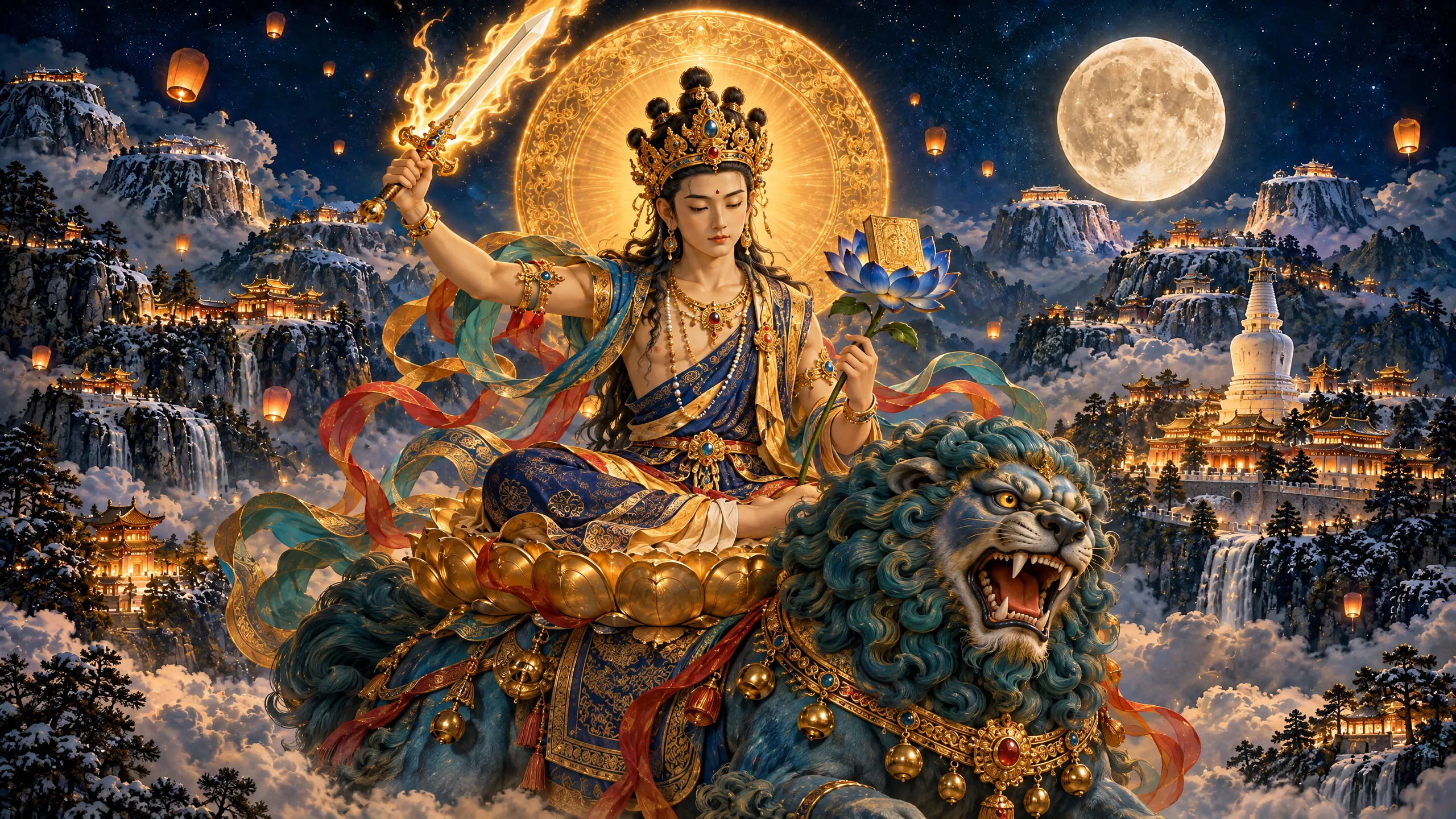
Visualize five topknots on his head. His right hand holds the sword of wisdom and his left hand holds a blue lotus, and on the flower rests a volume of the Perfection of Wisdom Sutra. His body is the color of turmeric.
The sword of wisdom, blue lotus, scripture and blue lion on this site’s cover art were painted from these same features:
- A youth with five topknots: the scripture speaks of “Manjushri in the form of a youth with five topknots” (文殊師利五髻童子形狀). Accounts differ on what the five topknots mean: one account says they stand for the five wisdoms of the Buddha; in Japan, Manjushri images have one, five, six or eight topknots, each matched to a different practice.
- Right hand raising the sword of wisdom: it cuts through ignorance and afflictions. Tibetan paintings often show it as a flaming sword.
- Left hand holding a blue lotus with the Perfection of Wisdom Sutra on it: the blue lotus is the utpala flower, and the book is the Perfection of Wisdom Sutra (Prajñāpāramitā), which stands for wisdom. Tibetan paintings often show the lotus blooming beside his ear, with the book resting on the flower.
- Body the color of turmeric: turmeric (鬱金) is a yellow spice, so Manjushri is often painted with a golden-yellow body.
- Riding a blue lion: accounts differ on what it symbolizes. Chinese sources mostly say the lion stands for majesty and courage; some English sources say it represents taming the mind with wisdom; Himalayan Art Resources (HAR) says the lion symbolizes his status as a “prince” (kumāra).
Mount Wutai: Manjushri’s Sacred Mountain
The “Dwelling Places of the Bodhisattvas” chapter (諸菩薩住處品) of the Avatamsaka Sutra says:
In the northeast there is a place called Mount Clear and Cool. Since ancient times, assemblies of bodhisattvas have dwelt there. Now there is a bodhisattva there named Manjushri, who, together with his retinue, an assembly of ten thousand bodhisattvas, constantly dwells there teaching the Dharma.
The sutra speaks only of a “Mount Clear and Cool” (Qingliangshan 清涼山) in the northeast; it does not mention Mount Wutai. It was Chinese Buddhists who identified Mount Clear and Cool with Mount Wutai in Shanxi, which is why Mount Wutai is also called Qingliangshan. “Wutai” (五台) means “five terraces”: five peaks whose summits are flat like platforms.
Today Mount Wutai ranks first among China’s Four Sacred Buddhist Mountains, each the sacred home of one bodhisattva:
| Mountain | Bodhisattva |
|---|---|
| Mount Wutai (五台山) | Manjushri |
| Mount Emei (峨眉山) | Samantabhadra (Puxian 普賢) |
| Mount Jiuhua (九華山) | Kṣitigarbha (Dizang 地藏) |
| Mount Putuo (普陀山) | Avalokiteśvara (Guanyin 觀音) |
In 2009, Mount Wutai was inscribed on the UNESCO World Heritage List as a “cultural landscape.”
The White Stupa on the Cover: Tayuan Temple’s Great White Stupa
On the right side of this site’s cover, a white Tibetan-style stupa rises among Chinese-style halls. It isn’t the artist’s invention: Mount Wutai really has such a stupa, the Great White Stupa of Tayuan Temple (塔院寺大白塔), which is also regarded as the symbol of Mount Wutai.
- Height: records differ, from about 54 to 75 meters (roughly 177 to 246 feet).
- An earlier pagoda: when the Japanese monk Ennin (圓仁) came to Tang China to study the Dharma, he already recorded a two-story octagonal pagoda here.
- Yuan dynasty: according to the records, it was built in the fifth or sixth year of the Dade era (1301 or 1302; accounts differ) under the direction of the Nepalese master craftsman Araniko (Anige 阿尼哥); one account says the old pagoda was enclosed inside the new stupa.
- Ming dynasty: in 1407 (the fifth year of Yongle), the Yongle Emperor (明成祖) had it restored at the request of the fifth Karmapa (honored in China as 大寶法王, “Great Treasure Dharma King”). Some scholars believe that only then was the octagonal Chinese-style pagoda rebuilt as a round Tibetan-style stupa. From 1579 to 1582 (the seventh to tenth years of Wanli), Empress Dowager Li (李太后) paid for a major restoration that gave the stupa its present form.
- What’s inside: tradition holds that relics of Shakyamuni Buddha are enshrined inside. A stele inscription by the Ming statesman Zhang Juzheng (張居正) says that after the ancient Indian king Ashoka obtained the Buddha’s relics, he built stupas to enshrine them, and “the stupa of Lingjiu Mountain (靈鷲山) at Wutai today is one of them.”
- Manjushri’s Hair Stupa: east of the Great White Stupa stands a smaller stupa. The Gazetteer of Mount Qingliang (清涼山志) records that Manjushri once came here in the form of a poor woman and left behind a lock of hair, and later people built a stupa to enshrine it.
Why Is There a Tibetan Stupa in a Chinese Temple?
Because Mount Wutai is a holy site shared by Chinese and Tibetan Buddhism:
- Chinese Buddhism: Mount Wutai became Manjushri’s sacred site in Chinese Buddhism very early on, and its temples are built in the Chinese style.
- Yuan dynasty: the Mongol-founded Yuan dynasty revered Tibetan Buddhism. In 1260, Kublai Khan named the Tibetan lama Phagpa (八思巴) his National Preceptor; that same year, the Nepalese craftsman Araniko came to Tibet with about eighty artisans to build a stupa, and later went on to Dadu (present-day Beijing) to build the White Stupa of Miaoying Temple (妙應寺白塔). From then on, Tibetan-style white stupas became popular in China.
- Ming dynasty: the Yongle Emperor restored the Great White Stupa at the Karmapa’s request (see above).
- Qing dynasty: Qing emperors visited Mount Wutai many times. The World Heritage evaluation report says this was also a way of showing solidarity with the neighboring Mongols. Pusading (菩薩頂, “Bodhisattva Summit”) was converted into a Tibetan Buddhist monastery in 1656 (the thirteenth year of Shunzhi), and the stele the Qianlong Emperor erected there is carved in four languages: Manchu, Tibetan, Chinese and Mongolian. Tibetan monks honored the Qing emperors as “Manjushri Emperors” (文殊皇帝), and the Qianlong Emperor also saw himself as an emanation of Manjushri, leaving behind several portraits in which he appears as Manjushri.
That is how Mount Wutai became the only sacred Buddhist mountain in China where “blue temples” (青廟, Chinese Buddhist temples) and “yellow temples” (黃廟, Tibetan Buddhist temples) stand side by side. One scholarly study points out that at Tayuan Temple the Tibetan-style white stupa came first, and the Chinese-style halls were built around it later. The World Heritage evaluation report likewise describes the site as a fusion of Chinese and Tibetan Buddhist architecture.
What Is This Kind of Stupa Called?
The Chinese word ta (塔, “pagoda” or “stupa”) comes from the Sanskrit stūpa (meaning “heap”). It was transliterated as sudupo (窣堵坡) or zutapo (卒塔婆), shortened to ta (塔), and is also called fota (佛塔, “Buddha tower”) or sheli ta (舍利塔, “relic tower”). The word futu (浮屠) in old texts was originally a transliteration of “Buddha,” and later came to mean a stupa as well.
A stupa like the Great White Stupa, with a rounded body shaped like an upturned alms bowl, is called an inverted-bowl stupa (覆缽式塔), also known as a lama stupa (喇嘛塔); in Tibetan it is a chorten (mchod rten, written 曲登 in Chinese). Stupas usually enshrine relics (the remains of the Buddha or of eminent monks), but they can also hold Buddha images or important scriptures.
Are Thai Chedis Also Stupas?
Yes. In Thailand a stupa is called a chedi (เจดีย์), from the Pali cetiya, a synonym of stupa. Thailand also has bell-shaped chedis.
Another kind of tall Thai tower, shaped like an ear of corn, is the prang (in Chinese 普朗塔, pulang ta). It derives from the towers of Khmer Hindu and Buddhist temples, and the most famous is at Wat Arun (Temple of Dawn, 黎明寺) in Bangkok. Thai scholars also classify the prang as a type of chedi, calling it a “prang-shaped chedi” (เจดีย์ทรงปรางค์).
How to Chant the Manjushri Mantra
- How many times: the scriptures mention 7, 21 and 108 repetitions. The Manjushri Bodhisattva Method says “recite it seven times or three times seven,” and with prayer beads “108 times, or a thousand, up to ten thousand times.” The chant on this site has 112 repetitions and lasts about 23 minutes.
- How to chant: the Five-Syllable Heart Dharani Chapter says “neither slow nor hurried, just loud enough to hear yourself”: not too fast or too slow, and so quietly that only you can hear it.
- When to chant: the scriptures suggest reciting at four times of day (“morning, noon, dusk and midnight”). In fact you can chant at any time; what matters is your focus.
- Do you need an empowerment? Accounts differ. Tang-dynasty esoteric scriptures require you to receive an empowerment (abhiṣeka) first, and say that “this dharani should be kept strictly secret.” Some modern Tibetan teachers, on the other hand, hold that chanting the mantra of a peaceful deity like Manjushri without an empowerment is not a fault, only less beneficial. If you want to learn the complete practice, it’s best to ask a qualified teacher.
- Listening before sleep: when you listen to the Manjushri mantra chant at bedtime, you can recite along silently or simply listen quietly, and let your mind settle little by little.
References
- Amoghavajra (Bukong 不空), Tang dynasty: 《金剛頂經瑜伽文殊師利菩薩法》 (Manjushri Bodhisattva Method from the Vajraśekhara Yoga; CBETA T1171)
- Amoghavajra (Bukong 不空), Tang dynasty: 《金剛頂超勝三界經說文殊五字真言勝相》 (Supreme Marks of Manjushri’s Five-Syllable Mantra, from the Vajraśekhara Sutra on Surpassing the Three Realms; CBETA T1172)
- Amoghavajra (Bukong 不空), Tang dynasty: 《五字陀羅尼頌》 (Verses on the Five-Syllable Dharani; CBETA T1174)
- Vajrabodhi (Jingangzhi 金剛智), Tang dynasty: 《金剛頂經曼殊室利菩薩五字心陀羅尼品》 (Five-Syllable Heart Dharani Chapter of Mañjuśrī Bodhisattva from the Vajraśekhara Sutra; CBETA T1173)
- Kumārajīva (Jiumoluoshi 鳩摩羅什), Later Qin dynasty: 《摩訶般若波羅蜜經》 (Large Perfection of Wisdom Sutra; CBETA T0223)
- Kumārajīva (Jiumoluoshi 鳩摩羅什), Later Qin dynasty: 《維摩詰所說經》 (Vimalakīrti Sutra; CBETA T0475)
- Kumārajīva (Jiumoluoshi 鳩摩羅什), Later Qin dynasty: 《大智度論》 (Treatise on the Great Perfection of Wisdom; CBETA T1509)
- Śikṣānanda (Shichanantuo 實叉難陀), Tang dynasty: 《大方廣佛華嚴經》 (Avataṃsaka Sūtra, Flower Garland Sutra; CBETA T0279)
- 《佛頂尊勝陀羅尼經》序 (Preface to the Uṣṇīṣa Vijaya Dhāraṇī Sutra; CBETA T0967)
- Zanning (贊寧), Song dynasty: 《宋高僧傳》 (Song Biographies of Eminent Monks; CBETA T2061)
- 《碧巖錄》 (Blue Cliff Record; CBETA T2003)
- Yu Siqi (余思奇) and Fujikawa Masaki (藤川昌樹), 〈五台山塔院寺の建築の構成とその変容〉 (The Architectural Composition of Tayuan Temple on Mount Wutai and Its Transformation), 《日本建築学会計画系論文集》 (Journal of Architecture and Planning, Transactions of AIJ) 87(799), 2022
- UNESCO World Heritage Centre, Mount Wutai (including the 2009 ICOMOS evaluation report)
- 國立故宮博物院 (National Palace Museum), Chengde Summer Resort exhibition page
- Himalayan Art Resources: Manjushri
- 84000: Mañjuśrī
- Thubten Chodron, Manjushri’s seed syllable (2015)
- Drukpa Choegon: On Vajrayana mantra
- 維基百科:文殊菩薩 (Chinese Wikipedia: Manjushri)
- 維基百科:五臺山 (Chinese Wikipedia: Mount Wutai)
- 維基百科:塔院寺 (Chinese Wikipedia: Tayuan Temple)
- 維基百科:覆缽式塔 (Chinese Wikipedia: Inverted-bowl stupa)
- Wikipedia: Manjushri
- Wikipedia: Prang
- เจดีย์ (Thai Wikipedia: Chedi)
- Encyclopaedia Britannica, Om