
How to Write and Pronounce the Medicine Buddha Mantra
The Medicine Buddha mantra is a Sanskrit mantra. The version usually chanted in Taiwan came by way of Tibetan Buddhism, so it is written in several ways:
| Source | Spelling |
|---|---|
| Common in Taiwan (Chinese characters) | 喋雅他 嗡 貝堪則 貝堪則 瑪哈 貝堪則 喇雜 薩目嘎喋 梭哈 (pinyin: die ya ta weng bei kan ze bei kan ze ma ha bei kan ze la za sa mu ga die suo ha) |
| Bodhi Meditation (菩提禪修)[22] | 喋雅他 嗡 貝堪則 貝堪則 瑪哈 貝堪則 喇雜 薩目嘎喋 娑哈 |
| Penor Rinpoche’s recitation[23] | 爹 雅 他 唵 貝 看 則 貝 看 則 瑪 哈 貝 看 則 喇 扎 沙母恩 嘎 得 梭哈 |
| Qing-dynasty Ritual of Offerings to the Seven Medicine Buddhas (藥師七佛供養儀軌如意王經)[7] | 答達鴉塔阿鄂嘛白厄卡雜葉白厄卡雜葉嘛哈阿白厄卡雜葉白厄卡雜葉喇阿雜阿薩穆達噶得娑阿哈阿 (the last part of the long mantra, transcribed in Chinese characters) |
| Sanskrit[21] | tadyathā oṃ bhaiṣajye bhaiṣajye mahābhaiṣajye rāja samudgate svāhā |
| Tibetan pronunciation[21] | teyata om bhekanze bhekanze maha bhekanze radza samudgate soha |
A few points to keep in mind when chanting:
- Sanskrit and Tibetan pronunciation differ: modern Tibetan says ṣa like kha, and writes Sanskrit ja with the Tibetan dza, so bhaiṣajye becomes bekandze and rāja becomes radza.[32] Svāhā is said soha in Tibetan; Wildmind notes that this is technically wrong in Sanskrit, but it has been said this way in Tibet for centuries.[20] The Taiwanese spellings 貝堪則 (bei kan ze), 喇雜 (la za) and 梭哈 (suo ha) all follow the Tibetan pronunciation, and Bodhi Meditation describes them as a Tibetan Buddhist transliteration.[22]
- Samudgate is usually said sa-mung-ga-te in Tibetan.[19,20]
- Is tadyathā said every time? Sources differ: the Tibetan canon’s Essence Dhāraṇī of the Medicine Buddha begins with om, without tadyathā.[13] Wildmind says it is “not really part of the mantra, but more of an introduction.”[20] Lama Zopa Rinpoche, on the other hand, says people usually recite “TADYATHA OM BHEKHANDZYE…,”[16] and FPMT’s recitation text also begins with TADYATHA.[17] We found no source saying to say tadyathā only the first time.
- Some versions add one more bhekandze: some Tibetan liturgies add one more bhekhandzye before raja, and so does the Qing translation.[16,7] FPMT puts it in brackets, and Lama Zopa Rinpoche says texts differ and either way is fine.[16,17] The common Taiwanese spelling does not have it.
Our chant follows the Tibetan pronunciation and starts every line with tadyathā, matching the spelling in its title.
What Does the Medicine Buddha Mantra Mean?
| Word | Meaning |
|---|---|
| tadyathā (喋雅他) | “the mantra says,” the opening of a mantra[9]; Wildmind translates it “thus”[20] |
| oṃ (嗡) | Yinshun 印順 gives two senses, “taking refuge” and “awakening attention”[9]; one Tibetan teaching says its three sounds a, o, ma stand for the Buddha’s body, speech and mind[19] |
| bhaiṣajye (貝堪則) | medicine, healing[15]; Yinshun reads the three in a row as “Medicine! Medicine! Medicine!”[9] |
| mahā (瑪哈) | great[20] |
| rāja (喇雜) | king[32,20]; the Medicine Buddha is also called Bhaiṣajyarāja, “King of Medicine”[20] |
| samudgate (薩目嘎喋) | risen up, appeared[15]; Yinshun explains it as “saving all beings”[9] |
| svāhā (梭哈) | the closing word of a prayer, “hail, may a blessing rest on it”[15]; Yinshun explains it as “may it be quickly accomplished”[9] |
Wildmind translates the whole line as: “Hail! Appear, O Healer, O Healer, O Great Healer, O King of Healing!”[20] Explaining the long mantra, Yinshun says its first half takes refuge in the Medicine Buddha and asks for his blessing, and its second half asks for medicine, so that the sickness of all beings is healed at once.[9]
The grammar of bhaiṣajye is disputed: Wildmind reads it as a call, “O Healer,”[20] while Chinese Wikipedia glosses it as “in the medicine.”[35]
The Tibetan explanation: Lama Zopa Rinpoche says bekandze means “eliminating pain”: the first removes suffering, the second removes its cause, karma and disturbing thoughts; maha bekandze is the “great eliminating,” which removes even the subtle imprints in the mind.[18,19]
Where Does the Medicine Buddha Mantra Come From?
The Medicine Buddha has two mantras, a long one and a short one. Chinese Buddhist temples chant the long one in their morning service; it is called the Medicine Buddha Consecration Mantra (藥師灌頂真言). The heart-mantra chants popular in Taiwan use the short Tibetan one, the Medicine Buddha heart mantra (藥師佛心咒).
The Long Mantra: the Medicine Buddha Consecration Mantra
The long mantra comes from the Sutra of the Original Vows of the Seven Medicine Buddhas (藥師琉璃光七佛本願功德經), translated by Yijing 義淨 in the Tang dynasty.[1] The sutra says the Medicine Buddha entered a samādhi called “removing the suffering of all beings,” sent out a great light from the top of his head, and spoke this mantra within the light:[1]
南謨薄伽伐帝 鞞殺社寠嚕 薜琉璃鉢喇婆 曷囉闍也 呾他揭多也 阿囉𠿒帝 三藐三勃陀也呾姪他唵 鞞殺逝鞞殺逝 鞞殺社三沒揭帝 莎訶
- One of the Ten Small Mantras: the Medicine Buddha Consecration Mantra is one of the Ten Small Mantras chanted in the morning service of Chinese monasteries.[32] The Ming-dynasty master Zhuhong 袾宏 (Lianchi 蓮池) already listed it under the morning service in his liturgy book.[8]
- Xuanzang’s translation originally had no mantra: the popular printed version of Xuanzang’s 玄奘 Sutra of the Original Vows of the Medicine Buddha (藥師琉璃光如來本願功德經) includes this mantra, but the base text of the Taishō canon does not; it appears only in a textual note.[2] Yinshun says this passage “was copied out of Yijing’s translation and inserted.”[9]
- An earlier short mantra: the end of the twelfth scroll of the Consecration Sutra (灌頂經), translated in the Eastern Jin dynasty, also has a Medicine Buddha mantra. It has tadyathā (哆姪他) but no om (唵).[3]
- The Sanskrit sutra has no mantra: neither the Sanskrit nor the Tibetan translation of the Medicine Buddha Sutra contains this mantra.[14,10]
The core of the long mantra is oṃ bhaiṣajye bhaiṣajye bhaiṣajya samudgate svāhā, with no mahā and no rāja.[1,5]
The Short Mantra: the Tibetan Medicine Buddha Heart Mantra
The short mantra, with mahā and rāja, comes from the Tibetan canon and Tibetan practice:
- The Essence Dhāraṇī of the Medicine Buddha: the Tibetan canon has a dhāraṇī whose Tibetan name, snying po’i gzungs, means “essence dhāraṇī,” or heart mantra. Its mantra is oṃ bhaiṣajye bhaiṣajye mahābhaiṣajye bhaiṣajyarājasamudgate svāhā.[13] It does not survive in Sanskrit and was never translated into Chinese.[13]
- A mantra for giving medicine: another text, A Mantra for Incanting Medicines When Administering Them, begins its mantra with tadyathā.[12] 84000 says the Āyurveda books of the Indian physician Vāgbhaṭa, from around 600 CE, took this mantra in, to bless a medicinal drink before giving it to the sick.[12]
- The Chinese canon includes it only once: in the Chinese canon, the form with mahā and rāja appears only in a Qing-dynasty ritual translated from Tibetan, the Ritual of Offerings to the Seven Medicine Buddhas.[7] Its mantra has 嘛哈阿 (mahā) and 喇阿雜阿 (rāja), Chinese characters spelling out the Tibetan sounds (the Sanskrit in brackets is our own matching).[7]
How Is the Heart Mantra Different from the Consecration Mantra?
| Heart mantra | Consecration mantra | |
|---|---|---|
| Length | Short | Long, opening with homage to the Medicine Buddha |
| Source | The Tibetan canon and Tibetan practice | Yijing's Sutra of the Original Vows of the Seven Medicine Buddhas |
| Pronunciation | Tibetan sounds | Chinese character readings |
| Usually heard in | Tibetan practice, heart-mantra chants | The Ten Small Mantras of the Chinese morning service |
| Mantra | 喋雅他 嗡 貝堪則 貝堪則 瑪哈 貝堪則 喇雜 薩目嘎喋 梭哈 | 南無薄伽伐帝 鞞殺社 窶嚕薜琉璃 缽剌婆 喝囉闍也 怛他揭多耶 阿囉喝帝 三藐三勃陀耶 怛姪他 唵 鞞殺逝 鞞殺逝 鞞殺社 三沒揭帝 莎訶 |
The consecration mantra in the table is written as in Zhuhong’s liturgy book.
What Are the Benefits of the Medicine Buddha Mantra?
Healing illness: every source agrees on this one. Yijing’s translation says to recite the mantra 108 times over food, medicine or water without insects and give it to the sick person, and “all their sickness and suffering will be wiped out.”[1] The text in the Tibetan canon is a mantra for blessing medicine before giving it.[12] Lama Zopa Rinpoche also says reciting it makes the medicine you take or give more powerful.[18] These are religious claims; please still see a doctor when you are ill.
Long life, and no untimely death: Yijing’s translation says “free of illness, with lengthened years”;[1] the ritual translated by Bukong 不空 (Amoghavajra) says it frees one from the nine untimely deaths and carries one beyond all suffering;[4] and the Tibetan Vaiḍūryaprabha Dhāraṇī says those who recite it will not fall ill, will live long and will not die an untimely death.[11]
Wishes fulfilled, and rebirth in his pure land: Yijing’s translation says:[1]
If there is something you seek, recite it with a sincere mind and you will get all you wish: no illness and lengthened years; and after this life ends you will be born in his world, never fall back, and go on to awakening.
Bukong’s ritual adds that the mantra clears away “all the heavy wrongs of past births and deaths.”[4]
At the time of death: FPMT lists it among the ten powerful mantras for the time of death, and Lama Zopa Rinpoche says to recite it in the dying person’s ear.[18]
Yinshun cautions that, compared with reciting the Medicine Buddha’s name, the mantra’s benefit is narrower: it is mainly for healing.[9]
Note: We have not found any source saying that this mantra helps with sleep. The only mention of sleep in the Medicine Buddha Sutra (Xuanzang's translation) is Mañjuśrī's vow that people will hear the Buddha's name "even in their sleep," and that is about his name, not the mantra. Listening to it at bedtime is simply one way to let the mind settle.
Who Is the Medicine Buddha?
The Medicine Buddha’s full name is Bhaiṣajyaguru-vaiḍūrya-prabha-rāja, “Medicine Master and King of Lapis Lazuli Light” (藥師琉璃光如來 in Chinese, Sangye Menla in Tibetan). He is the buddha of healing and medicine in Mahayana Buddhism.[32] In China he is often called the “Medicine Buddha who removes calamities and lengthens life” (消災延壽藥師佛).[35]
- Lapis lazuli: Chinese Wikipedia describes 琉璃 as “a natural blue gemstone of India that gives off a pure light, one of the seven treasures of Buddhism.”[35] The Sanskrit vaiḍūrya is usually translated as lapis lazuli, though one scholar argues it first meant beryl.[32]
- The king of physicians: the Medicine Buddha cures suffering with the medicine of his teachings.[32] In Japan he is said to heal the sickness of ignorance, and unusually for a buddha, people pray to him for benefits in this life.[38]
- How the sutra begins: Shakyamuni Buddha, staying under a tree of music in the city of Vaiśālī (廣嚴城), answers a request from Mañjuśrī and tells of a buddha far away to the east.[2]
The Twelve Great Vows of the Medicine Buddha
While he was still on the bodhisattva path, the Medicine Buddha made twelve great vows. Here they are, following Xuanzang’s translation, each with a line from the sutra:[2]
- Light for all: that all beings would have the marks of a buddha like him, “all beings just like me.”
- A body like lapis: “a body like lapis lazuli, clear inside and out,” brighter than the sun and moon, so that “beings in darkness all find the dawn.”
- Nothing lacking: “let no being lack anything.”
- The Great Vehicle: that those on wrong paths turn to the path of awakening, “all set firmly in the Great Vehicle.”
- Pure precepts: that those who break the precepts, “having heard my name, become pure again and do not fall into the lower realms.”
- Whole in body: that the disabled, the blind, the deaf and the mute become “whole in all their faculties, free of all sickness.”
- Healing and ease: that the sick with no doctor, no medicine and no home are healed: “once my name passes their ears, all their sickness is gone, and body and mind are at ease.”
- Rebirth as a man: that women who wish it are reborn as men.
- Free from Māra’s net: that beings “escape the net of Māra” and are “set in right view.”
- Free from sorrow: that prisoners and the punished are “freed from all sorrow and suffering.”
- Fed with Dharma: that the hungry are fed, “first with fine food and drink to fill the body, then with the taste of the Dharma.”
- Clothed: that the poor and cold “receive all kinds of fine clothing.”
In the oldest translation, the Consecration Sutra, one vow says the Medicine Buddha is “lofty and majestic like the moon among the stars, clearing the clouds of birth and death so that nothing is hidden.”[3]
Stories of the Medicine Buddha
The King of Physicians and His Two Sons
One story says that in the time of a buddha named Lightning Light (電光如來), a brahmin and his two sons vowed to heal the sick. The buddha renamed the father “King of Physicians” and the sons “Sunlight” and “Moonlight.”[36,29] The father later became the Medicine Buddha, and the sons became the bodhisattvas Sunlight and Moonlight.[36] Chinese Wikipedia says the story comes from a commentary on the Medicine Buddha Sutra (藥師經疏), as quoted in the Japanese Kakuzenshō (覺禪鈔).[36]
The 49 Lamps and the Life-Prolonging Banners
In the Medicine Buddha Sutra, the bodhisattva Jiutuo (救脫菩薩) tells a story: a man is gravely ill and dying, and his spirit is led before Yama, king of the dead. If his family takes refuge in the Medicine Buddha for him, has monks read the sutra, “lights lamps in seven tiers and hangs five-coloured life-prolonging banners,” his spirit may come back after seven to forty-nine days, “as if waking from a dream.”[2]
The full rite: read the sutra forty-nine times, “light forty-nine lamps,” and make seven images of the Medicine Buddha, with each lamp “as big as a cartwheel, its light unbroken for forty-nine days.”[2] Chinese temples still light 49 “long-life lamps” today.[32]
Why Is the Medicine Buddha Blue?
The sutra says only that the Medicine Buddha’s body is “like lapis lazuli,”[2] without naming a colour. The blue comes from lapis being a blue gemstone,[35] and from later rituals: a Yuan-dynasty ritual says “his body is blue,”[6] and a Qing-dynasty ritual says his body is “the colour of sapphire.”[7]
Tibet has another legend: someone asked the Medicine Buddha why he looked so dark. He answered: “I have all kind of disease in my body and it is therefore I have become so dark blue.”[27]
The Source of Tibetan Medicine
Tibetans say the Medicine Buddha gave medical teachings to his disciples in a medicine city called Tanaduk (“Auspicious to Behold”).[26] The root text of Tibetan medicine, the Four Medical Tantras (Gyushi), is written as a dialogue between two manifestations of the Medicine Buddha: the teacher Rigpa Yeshe and the chief disciple Yilekye.[26]
Japan: Temples Built for a Sick Spouse
In Japan, Emperor Tenmu commissioned Yakushi-ji in 680 as an offering for the recovery of his ailing consort.[33] In 747, Empress Kōmyō founded Shin-Yakushi-ji for Emperor Shōmu, who suffered from an eye ailment.[34]
The Three Holy Ones of the East, the Twelve Generals and the Seven Medicine Buddhas
The bodhisattvas Sunlight and Moonlight: the sutra says that in his pure land there are two great bodhisattvas, “one named Sunlight Shining Everywhere, the other Moonlight Shining Everywhere,” the leaders of countless bodhisattvas.[2] With the Medicine Buddha they are called the Three Holy Ones of the East (東方三聖).[35]
- What they stand for: “Sunlight stands for bright wisdom, and Moonlight for quiet compassion”; “moonlight is cool and quiet, and lights up the dark night.”[29]
- Where they stand: in Chinese and Japanese images, Sunlight stands at the Medicine Buddha’s left and Moonlight at his right; seen from the front, Moonlight is on the viewer’s left.[39,29]
- Moonlight’s birthday: in Taiwan, the 15th of the eighth lunar month, the Mid-Autumn Festival, “is also the birthday of the Moonlight Bodhisattva, and many temples hold Dharma services on this day.”[31]
The Twelve Generals: twelve yaksha generals, such as Kumbhīra (宮毘羅) and Vajra (伐折羅), “each with seven thousand yakshas as followers,” vow to protect anyone who keeps the sutra or the Medicine Buddha’s name.[2] Chinese Buddhism also matches the twelve generals to the twelve animals of the zodiac.[35]
The Seven Medicine Buddhas: Yijing’s translation adds six more buddhas of the east, each with his own vows; together they are the Seven Medicine Buddhas.[1,35] Tibetan Buddhism adds Shakyamuni Buddha to make the Eight Medicine Buddhas.[35]
What the Medicine Buddha Looks Like
“None of the four existing translations of the Medicine Buddha Sutra describe what the Medicine Buddha actually looks like”;[28] the sutra says only that his body is “like lapis lazuli, clear inside and out.”[2] The first rule for his image comes from the ritual translated by Bukong:[4]
The Tathāgata’s left hand holds a medicine vessel, also called a priceless jewel; his right hand forms the mudra of the three realms. He wears a kasaya, sits cross-legged, and is placed on a lotus seat.
In Chinese Buddhism: “the usual image in Chinese Buddhism has snail-shell curls, a medicine jar in the left hand, and the right hand in the gesture of fearlessness (or of giving).”[35] Some hold a medicine bowl or a lidded jar; the pagoda-holding form is “seen only in modern Chinese Buddhist temples”; and some Tang-dynasty images hold a monk’s staff.[28,35] Gold-bodied images are common in Taiwan too; the one at Nanshan Fangsheng Temple (南山放生寺), for example, has “sapphire-blue snail curls and golden features.”[30]
In Tibetan Buddhism:
- A dark blue body, like the colour of the sky, with one face and two hands.[24,27]
- The right hand rests before the right knee, palm out, in the gesture of supreme generosity, holding a sprig of myrobalan (Tibetan arura, Sanskrit haritaki).[24]
- The left hand rests in the lap in the gesture of meditation, holding a bowl of nectar.[24,35]
- He wears a monk’s robes and no crown, appearing as a buddha’s emanation body.[24]
- He sits in vajra posture on a moon disc above a lotus, on a lion throne.[24]
What is myrobalan? Myrobalan, also called haritaki, is a fruit. The Golden Light Sutra says: “haritaki alone has all six tastes; it cures every illness, the king of medicines.”[35]
How do you tell the Medicine Buddha apart? Shakyamuni, Amitabha and the Medicine Buddha may all hold a bowl in the lap, but only the Medicine Buddha also holds a medicinal plant in his right hand.[25]
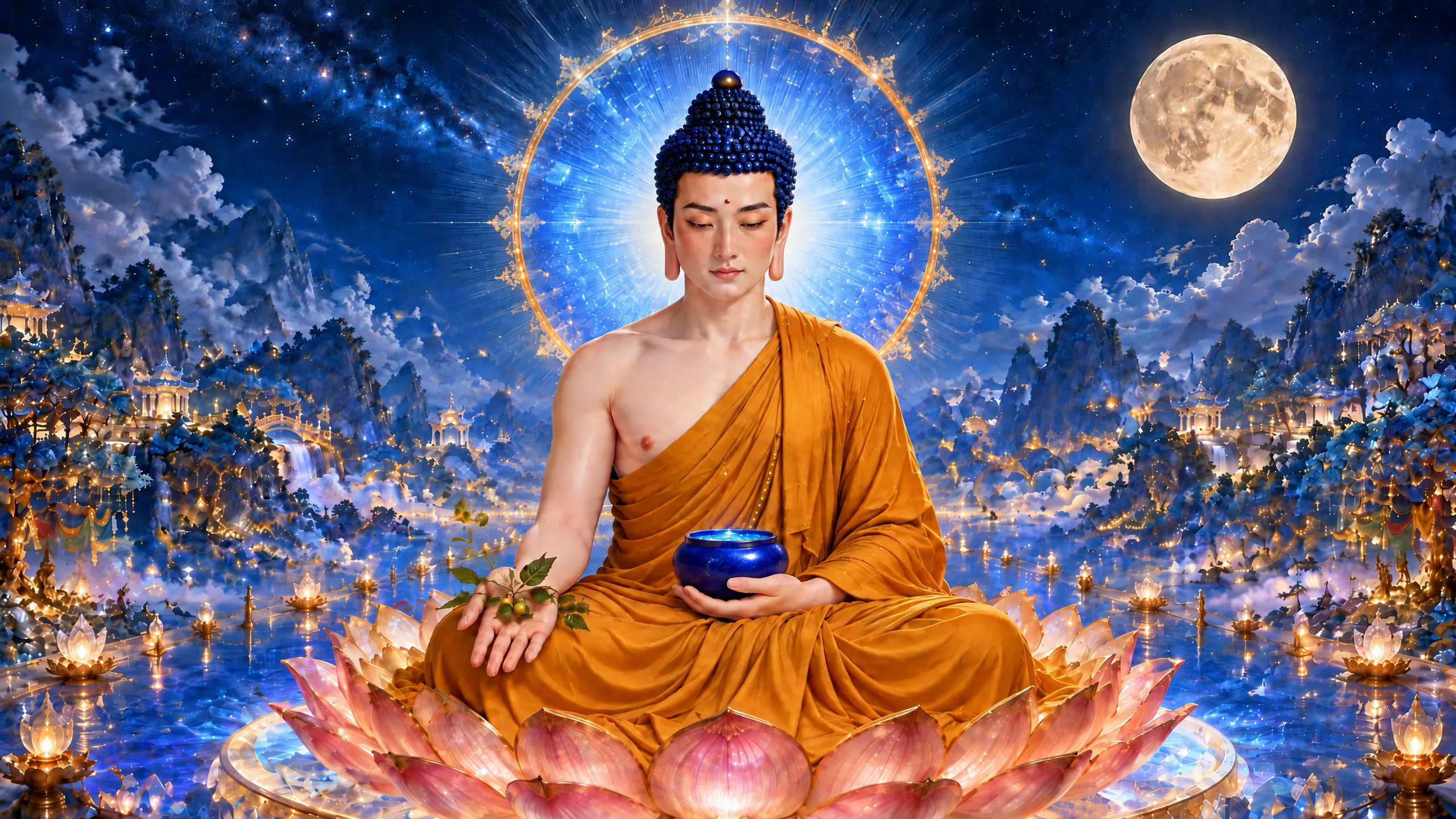
The Lapis Light, Full Moon and Oil Lamps on the Cover
Our cover shows the Eastern Pure Lapis Land on a moonlit night, with details taken from the Medicine Buddha Sutra:[2]
- The blue halo: the Medicine Buddha’s “lapis light.” The second vow says his light is “adorned with a net of flames, surpassing the sun and moon.”
- The lapis ground and palaces: in his pure land, “lapis lazuli is the ground, golden ropes mark the roads, and the city walls, gates, palaces, halls, windows and nets are all made of the seven treasures.”
- The oil lamps and banners: they echo the forty-nine lamps and the “five-coloured life-prolonging banners.”
- The full moon: the bodhisattva Moonlight.
- The myrobalan in the right hand and the bowl in the left: following the Tibetan image.[24]
The Medicine Buddha on the cover has natural skin, not the blue body of Tibetan art or the gold body common in Chinese art, and the bodhisattvas Sunlight and Moonlight are not shown; for the traditional image, see the section above.
The Medicine Buddha’s Pure Land and Holy Places
- The Eastern Pure Lapis Land (東方淨琉璃世界): it lies “to the east, beyond buddha-lands as many as the sands of ten Ganges rivers.” There, “lapis lazuli is the ground, golden ropes mark the roads,” and it is “as adorned with merit as the Western Pure Land of Bliss, no different.”[2]
- Tanaduk, the medicine city: the Medicine Buddha’s palace city in Tibetan tradition. A crystal palace stands at its centre, and his throne is made of lapis lazuli; outside the city are four medicine mountains, and the eastern one is covered with a forest of myrobalan.[27]
- Yakushi-ji, Nara, Japan: the Golden Hall houses the Medicine Buddha triad between two three-storey pagodas; the East Pagoda dates from 730.[33]
- Shin-Yakushi-ji, Nara: the Twelve Generals stand in a circle around the Medicine Buddha, facing outward.[34]
- Jōruri-ji, Kyoto: the temple is named after the Medicine Buddha’s Eastern Pure Lapis Land. A three-storey pagoda on the east bank of its pond houses the Medicine Buddha, and the main hall on the west bank houses nine Amitabha images.[40]
- Konponchūdō, Enryaku-ji, Mount Hiei: its main image is the Medicine Buddha, and before it burns the “inextinguishable Dharma lamp,” kept alight since the time of Saichō.[41]
- Chagpori, Lhasa, Tibet: a hill south of the Potala, whose Chinese name 藥王山 (“Medicine King Hill”) comes from the medical college that once stood there, dedicated to the Medicine Buddha.[37]
- Taiwan: temples with the Medicine Buddha as their main image include Yuanshan Yaoshi Temple (圓山藥師寺) in Taipei and Nanshan Fangsheng Temple (南山放生寺) in Zhonghe, New Taipei.[30]
How to Chant the Medicine Buddha Mantra
- How many times: Yijing’s translation says to recite it 108 times over food, medicine or water;[1] Yixing’s 一行 ritual says “seven times up to 108”;[5] and Bukong’s ritual says a practice is complete after “reciting the mantra a hundred thousand times.”[4] The Tibetan Vaiḍūryaprabha Dhāraṇī gives 49, 1,008 and 49,000 times.[11] Our chant has 108 repetitions and lasts about 46 minutes.
- Do you need an initiation? FPMT marks this mantra “Unrestricted”: anyone can recite it, though it is best to receive the oral transmission from a teacher first.[18]
- What if my pronunciation isn’t perfect? Lama Zopa Rinpoche teaches that a mantra’s power comes from faith, not from correct Sanskrit sounds, and notes that most Tibetans never learn Sanskrit.[16]
- Who to chant for: for yourself, or for a sick friend or relative; or, as the sutra says, recite it over food, medicine or clean water and give it to the sick person.[1] You can also recite it softly in the ear of someone who is dying.[18]
- Listening before sleep: when you listen to the Medicine Buddha mantra chant at bedtime, you can recite along silently, or simply listen quietly and let your mind settle.
References
- Yijing 義淨 (Tang), 《藥師琉璃光七佛本願功德經》 (Sutra of the Original Vows of the Seven Medicine Buddhas) (CBETA T0451)
- Xuanzang 玄奘 (Tang), 《藥師琉璃光如來本願功德經》 (Sutra of the Original Vows of the Medicine Buddha) (CBETA T0450)
- Śrīmitra 帛尸梨蜜多羅 (Eastern Jin), 《佛說灌頂經》 (Consecration Sutra), scroll 12 (CBETA T1331)
- Bukong 不空 (Amoghavajra, Tang), 《藥師如來念誦儀軌》 (Recitation Ritual of the Medicine Buddha) (CBETA T0924A)
- Yixing 一行, 《藥師琉璃光如來消災除難念誦儀軌》 (Medicine Buddha Recitation Ritual for Removing Calamities) (CBETA T0922)
- Shaluoba 沙囉巴 (Yuan), 《藥師琉璃光王七佛本願功德經念誦儀軌供養法》 (Offering Ritual of the Seven Medicine Buddhas) (CBETA T0926)
- Gongbuchabu 工布查布 (Gombojab, Qing), 《藥師七佛供養儀軌如意王經》 (Ritual of Offerings to the Seven Medicine Buddhas) (CBETA T0927)
- Zhuhong 袾宏 (Ming), 《雲棲法彙》 (Collected Works of Yunqi), selections (CBETA JB277)
- Yinshun 印順, 《藥師經講記》 (Lectures on the Medicine Buddha Sutra) (CBETA Y0004)
- 84000: The Detailed Account of the Previous Aspirations of the Blessed Bhaiṣajyaguruvaiḍūryaprabha (Toh 504)
- 84000: The Vaiḍūryaprabha Dhāraṇī (Toh 505)
- 84000: A Mantra for Incanting Medicines When Administering Them (Toh 505a)
- 84000: The Essence Dhāraṇī of the Tathāgata Bhaiṣajyaguru (Toh 862)
- Bhaiṣajyaguruvaidūryaprabharājasūtram, the Sanskrit Medicine Buddha Sutra (DSBC)
- Monier-Williams, Sanskrit-English Dictionary: bhaiṣajya, samudgata, svāhā
- Lama Zopa Rinpoche, Teachings from the Medicine Buddha Retreat (2001 retreat)
- FPMT, Medicine Buddha Mantras (2008)
- FPMT, Medicine Buddha Mantras – MP3 Download
- Drepung Gomang, Mantra of the Medicine Buddha
- Wildmind: Medicine Buddha mantra
- Dudjom Lingpa, Medicine Buddha Visualisation and Mantra (Lotsawa House, 2021)
- Bodhi Meditation 菩提禪修, 〈認識藥師佛信仰、名號由來〉 (The Medicine Buddha and his name) (2021)
- Penor Rinpoche 貝諾法王, 〈藥師佛心咒〉 (Medicine Buddha heart mantra) (KKBOX)
- Himalayan Art Resources: Medicine Buddha
- Himalayan Art Resources: Buddha iconography
- Rubin Museum of Art: The Inner Cosmology of Tibetan Medicine
- Natalia D. Bolsokhoyeva, “The Mandala of the Medicine Buddha,” Buddhist Himalaya IV (1992) (NTU Digital Library of Buddhist Studies)
- 〈藥師佛的形象〉 (The image of the Medicine Buddha), 《香光莊嚴》 (Hsiang Kuang Chuang Yen) no. 125, 2016 (臺大佛學數位圖書館 (NTU Digital Library of Buddhist Studies))
- 〈藥師佛的脅侍菩薩〉 (The Medicine Buddha’s attendant bodhisattvas), 《香光莊嚴》 (Hsiang Kuang Chuang Yen) no. 125, 2016 (臺大佛學數位圖書館 (NTU Digital Library of Buddhist Studies))
- Chen Ching-hsiang 陳清香, 〈《藥師經》所彰顯的藥師願行:兼談藥師佛造像藝術〉 (The Medicine Buddha’s vows in the sutra, and Medicine Buddha images), 《慧炬》 (Wisdom Torch) no. 623, 2020 (臺大佛學數位圖書館 (NTU Digital Library of Buddhist Studies))
- Baobi 保庇網, 〈中秋夜持大悲咒 月光菩薩來庇佑遠離煩惱病苦〉 (On Mid-Autumn night, the Moonlight Bodhisattva protects) (2021) (NOWnews)
- Wikipedia: Bhaisajyaguru
- Wikipedia: Yakushi-ji
- Wikipedia: Shin-Yakushi-ji
- 維基百科:藥師佛 (Chinese Wikipedia: Medicine Buddha)
- 東方三聖 (Chinese Wikipedia: Three Holy Ones of the East)
- 藥王山 (Chinese Wikipedia: Chagpori)
- 薬師如来(日文) (Japanese Wikipedia: Medicine Buddha)
- 薬師三尊(日文) (Japanese Wikipedia: Medicine Buddha triad)
- 浄瑠璃寺(日文) (Japanese Wikipedia: Jōruri-ji)
- 延暦寺(日文) (Japanese Wikipedia: Enryaku-ji)