
How to Write and Pronounce the Mantra
The Mantra for Eliminating Fixed Karma (滅定業真言, Miè Dìngyè Zhēnyán) is a Sanskrit mantra transliterated into Chinese characters: each character stands for a sound, not a meaning. Versions differ slightly in the characters they use:
| Source | Written form |
|---|---|
| Common in Taiwan | 唵 缽囉末鄰陀寧 娑婆訶 |
| Ming dynasty: Zhuhong (袾宏), ed., Essentials of Daily Recitations from the Sutras (諸經日誦集要)[2] | 唵 缽羅末 鄰陀𩕳 娑婆訶 |
| Qing dynasty: 1662 (first year of Kangxi) woodblock edition of the Essentials of Daily Recitations[2] | 唵缽羅末鄰阤𩕳娑婆訶 |
| Qing dynasty: Yirun (儀潤), Commentary on the Baizhang Rules of Purity (百丈清規證義記)[24] | 唵 鉢囉末憐陀𩕳 娑婆訶 |
| Tang dynasty: “Ksitigarbha Bodhisattva Dharma-Body Seal Mantra” in the Collected Dharani Sutra (陀羅尼集經) (the source, according to one account)[1,36] | 唵 波囉(二合)末馱儞 莎訶 |
A few points on pronunciation:
- 唵 is also written 嗡, and is pronounced Om.[18,46]
- 缽囉 (Bo La): the Tang text adds the note 二合, “two combined,” under 波囉, meaning the two characters merge into one syllable (pra).[1,30] In Taiwan today they are usually read separately as Bo La, and our chant does the same.
- 寧 (Ning): Ming and Qing liturgy books use the rare character 𩕳;[2] today it is usually written 寧.
- 娑婆訶 is also written 莎訶 or 梭哈. The Sanskrit is svāhā, pronounced So-ha.
Our chant pronounces the mantra as: Om Bo La Mo Ling Tuo Ning So-ha.
Where Does the Mantra for Eliminating Fixed Karma Come From?
It Is Not in the Ksitigarbha Sutra
Many people chant this mantra right after reciting the Sutra of the Fundamental Vows of Ksitigarbha Bodhisattva (地藏菩薩本願經), usually called the Ksitigarbha Sutra (地藏經), and many liturgy editions of the sutra print it after the text. But the sutra itself does not contain this mantra. The term “fixed karma” (定業) never even appears in it.[7]
The Ming-Dynasty Evening Service: The Mengshan Food Offering
The earliest known text to call it the “Mantra for Eliminating Fixed Karma” is the Essentials of Daily Recitations from the Sutras (諸經日誦集要), compiled by the Ming-dynasty master Lianchi Zhuhong (蓮池袾宏, 1535–1615). It appears in the evening service’s Mengshan Food Offering Rite (蒙山施食儀), in a series of mantras that includes the Mantra for Breaking Open the Hells and the Mantra for Eliminating Karmic Obstacles. The text notes, “each of the following is recited three times.”[2]
The Mengshan Food Offering is a rite of giving food to hungry ghosts. Venerable Yinshun (印順) wrote, “In the evening service of our country, there is the Mengshan Food Offering Rite,” and Chinese Buddhist monasteries still recite it in their evening services today.[20]
The name is not entirely consistent either: the 1662 woodblock edition from the early Qing calls it the “Ksitigarbha Bodhisattva Mantra for Eliminating Wrongdoing” (地藏菩薩滅罪真言).[2] In English you will also see it called the Ksitigarbha Fixed Karma Mantra or the Mantra to Eliminate Fixed Karma.
A Tang-Dynasty Origin? (One Account)
Dharma Drum Publishing’s 50 Questions about Mantras (咒語50問) says: “The Mantra for Eliminating Fixed Karma comes from fascicle 6 of the Collected Dharani Sutra, where its original name is the Ksitigarbha Bodhisattva Dharma-Body Seal Mantra.”[36] The Collected Dharani Sutra (陀羅尼集經) is an esoteric scripture translated by Atikūṭa (阿地瞿多) in the Tang dynasty, during the Yonghui era (653–654). Its sixth fascicle gives the “Ksitigarbha Bodhisattva Dharma-Body Seal Mantra, No. 6” (地藏菩薩法身印呪第六) as:[1]
唵(一) 波囉(二合)末(平音)馱儞(二) 莎訶(三)
(The small notes are the translator’s: the numbers mark the phrases, 二合 means two characters read as one syllable, and 平音 means “read in the level tone.”)
The sound is very close to today’s mantra but not identical: 末馱儞 (mò tuó nǐ) versus 末鄰陀寧 (mò lín tuó níng). The sutra also never uses the name “eliminating fixed karma,” and the Ming and Qing liturgy books do not say the mantra comes from it.[1,2] So this is one account, and it cannot yet be confirmed.
Note: The Yoga Flaming Mouth rite (瑜伽燄口), a ceremony for feeding hungry ghosts, contains a different "Fixed Karma Mantra" (定業真言) that begins "唵 斡資囉(二合)……" (oṃ vajra…). It is a separate mantra from the Mantra for Eliminating Fixed Karma.
What Does the Mantra Mean?
What Is Fixed Karma?
Karma (業) simply means action. Buddhism teaches that actions leave behind a force that brings results in the future, called karmic retribution (果報). The Abhidharmakośa (俱舍論) divides karma into fixed karma (定業) and unfixed karma (不定業): fixed karma will definitely bring its results, while unfixed karma may not. Fixed karma is further divided into three kinds by when its results arrive: in this life (順現法受), in the next life (順次生受), or in some later life (順後次受).[11]
What kind of karma becomes fixed? A verse in the Abhidharmakośa says:[11]
Karma done with strong defilement or with a pure mind, karma done constantly, karma done toward a field of merit, and karma that harms one’s parents: such karma is fixed.
In other words, fixed karma includes acts done with intense afflictions, acts done with an exceptionally pure mind, acts repeated again and again, acts directed toward a “field of merit” (which the treatise explains as the Buddha, the Dharma and the Sangha, or people who have attained a noble fruit or deep meditation), and acts that harm one’s parents.[11]
The Ksitigarbha Sutra, in the chapter “The Names of the Hells” (地獄名號品), also warns how great the power of karma is:[7]
The power of karma is immense. It can rival Mount Sumeru, it is deeper than the vast ocean, and it can block the holy path. Therefore, beings should not take small wrongs lightly, thinking they carry no offense. After death there is retribution, and every last hair’s breadth of it is received.
What Each Word Means
| Word | Meaning |
|---|---|
| 唵 oṃ | A sacred seed syllable; a common opening for mantras[46] |
| 缽囉末鄰陀寧 | The Sanskrit original is uncertain; it is commonly said to be pramardane, meaning “crushing, destroying”[41] |
| 娑婆訶 svāhā | A closing word of prayer[47] |
The Sanskrit form often seen online is oṃ pramardane svāhā. In the Monier-Williams Sanskrit-English Dictionary, pramardana means “crushing, destroying,” which fits the word 滅 (miè, “eliminate”) in the mantra’s name.[41] However, we could not find a scholarly source for this form. It appears only on web pages that cite no source, and the Tang form 波囉末馱儞 does not match it exactly either.[1] So accounts differ on what the original Sanskrit of this mantra was.
Dharma Drum Publishing explains: “The original meaning of the Sanskrit is to subdue, scatter and crush all wrongdoing, karmic obstacles and evil karma, which is why it is called ‘eliminating fixed karma.’”[36]
Put simply, chanting this mantra is a prayer for Ksitigarbha’s power to dissolve karma created in the past, whose results were otherwise certain to come.
Can Fixed Karma Be Changed?
Buddhist scriptures often say that “fixed karma cannot be changed.” The Medicine Buddha Sutra (藥師經) translated by Yijing (義淨) in the Tang dynasty says that people who hear the names of the Buddhas will not fall into the evil paths, “except for fixed karma that cannot be changed.”[12] The Chan master Yuangui (元珪) also said there are “three things the Buddha cannot do,” and the first is:[15]
The Buddha can empty all forms and perfect the wisdom of all dharmas, but he cannot instantly extinguish fixed karma.
So why is there a mantra for “eliminating fixed karma”? Masters through the ages have taken different views:
- The Tang-dynasty Tiantai master Zhanran (湛然) said: “If the bond between the practitioner’s readiness and the Buddha’s response is strong, even fixed karma can be changed.”[13]
- The Tang-dynasty master Amoghavajra (不空) said that reciting dharanis, “if in accord with the three secret practices… can change fixed karma.”[14]
- The Tibetan master Tsongkhapa said that when one repents and counteracts wrongdoing with the “four powers,” even karma that is certain to bring results “is also said to be purifiable.”[16]
- At the end of the same passage, Chan master Yuangui also said: “Fixed karma does not last forever, either.”[15]
The late-Ming master Ouyi Zhixu (蕅益智旭, 1599–1655) put it most clearly:[3]
Shakyamuni Buddha said fixed karma cannot be saved, to chill the heart that would do wrong. Ksitigarbha Bodhisattva taught the Mantra for Eliminating Fixed Karma, to comfort the traveler at the end of the road.
That is, Shakyamuni said fixed karma cannot be rescued so that people will not dare to do evil, while the Mantra for Eliminating Fixed Karma is meant to comfort those who have run out of options. The two teachings have different purposes and do not contradict each other.
Zhixu also reminds us that chanting the mantra alone is not enough:[4]
Though the Great Being’s compassion is inconceivable and the mantra’s spiritual power is inconceivable, new misdeeds must still be cut off for good; only then will old faults all vanish.
In other words, although Ksitigarbha’s compassion and the power of the mantra are beyond imagining, we must also stop creating new bad karma from now on; only then can past wrongs be cleared away.
What Are the Benefits of Chanting the Mantra?
- Zhixu’s Rite of Praise, Repentance and Vows to Ksitigarbha Bodhisattva (讚禮地藏菩薩懺願儀) says that after the repentance ceremony, one should return to a quiet room and “either recite Ksitigarbha’s name, or hold the Mantra for Eliminating Fixed Karma, or contemplate the Great Being’s impartial Dharma body.” Practicing sincerely in this way, “one will surely eliminate obstacles.”
- The Republican-era Wondrous Treasure of Peace and Bliss (安樂妙寶) says: “If one can recite it twenty-one times a day, karmic obstacles will gradually dissolve of themselves.”
- Dharma Drum Publishing’s 50 Questions about Mantras says that chanting this mantra regularly “can remove karmic obstacles, resolve grudges and untie knots of enmity, and can also help liberate and benefit beings in the ghost realm.”
Zhixu himself chanted this mantra on a huge scale. In 1637 (the tenth year of Chongzhen), he set up a mantra altar for 110 days, from the 17th day of the fifth month to the 8th day of the ninth month. He personally recited the mantra five million times and urged his fellow practitioners to “together recite it one billion times.”
Who Is Ksitigarbha Bodhisattva?
Ksitigarbha’s Sanskrit name is Kṣitigarbha: kṣiti means “earth” and garbha means “womb” or “treasury,” so the name was translated into Chinese as Dizang (地藏), “Earth Store.” Xuanzang’s (玄奘) translation of the Sutra of the Ten Wheels of Ksitigarbha (地藏十輪經) praises him as “patient and unmoving like the great earth, deep and hidden in meditation like a secret treasury,” and these two lines are often used to explain his name. The Ming master Zhixu explained it like this: “In the sense of bearing and supporting, he is called ‘earth.’ In the sense of containing and embracing, he is called ‘store.’” He bears all things like the earth and holds everything like a treasury.
Ksitigarbha is the bodhisattva of the “age without a Buddha.” After Shakyamuni Buddha passed into nirvana and before Maitreya becomes a Buddha, there is no Buddha in the world, and Ksitigarbha saves beings in the meantime. In the chapter “The Gathering of Emanation Bodies” (分身集會品) of the Ksitigarbha Sutra, the Buddha entrusts him with this task:
Bring all beings of the Saha world, from now until Maitreya appears in the world, to liberation, so that they leave all suffering forever and meet Buddhas who predict their enlightenment.
Chinese Buddhism often speaks of “Manjushri of great wisdom, Samantabhadra of great practice, Guanyin of great compassion, Ksitigarbha of great vows” (大智文殊、大行普賢、大悲觀音、大願地藏). Ksitigarbha is known for his great vows. In Japan, he is called Jizō (地蔵) and is especially regarded as a protector of children.
Note: The Sutra of the Fundamental Vows of Ksitigarbha Bodhisattva is traditionally said to have been translated by Śikṣānanda (實叉難陀) in the Tang dynasty. Some scholars, however, argue that it was compiled in China between the Five Dynasties and the early Song. Accounts differ.
Where Does “Until the Hells Are Empty, I Will Not Become a Buddha” Come From?
Ksitigarbha’s most famous words are “Only when all beings are saved will I attain bodhi; until the hells are empty, I vow not to become a Buddha” (眾生度盡,方證菩提;地獄未空,誓不成佛). But these four phrases are not actually in the Ksitigarbha Sutra.[7] The closest passage in the sutra is the vow a young woman named Bright Eyes (光目女) made before a Buddha image:[7]
For hundreds of thousands of millions of eons to come, in every world, I vow to rescue all beings suffering for their wrongs in the hells and the three evil paths, and to free them from the hells, the evil destinies, the animal realm, the realm of hungry ghosts and the like. Only after all such people undergoing retribution have become Buddhas will I myself attain perfect enlightenment.
The four-phrase form comes from later ritual texts. For example, when the Yoga Essentials Flaming Mouth Food-Offering Rite (瑜伽集要焰口施食儀) invites Ksitigarbha, it says: “Only when all beings are saved will he attain bodhi; until the hells are empty he vows not to become a Buddha: the Great Sage, Ksitigarbha King Bodhisattva Mahasattva.”[17] Originally, “all beings saved” came first. The version so often heard today, 地獄不空,誓不成佛 (“until the hells are empty, I vow not to become a Buddha”), is a later wording.
Four Stories from the Ksitigarbha Sutra
In the Ksitigarbha Sutra, the Buddha tells four stories from Ksitigarbha’s past lives, and each one is about making a vow.[7]
The Elder’s Son: A Vow Inspired by a Buddha’s Majestic Form
Long ago, Ksitigarbha was the son of a great elder. When he saw the majestic, perfect features of the Tathagata Lion Sprint Complete with Ten Thousand Practices (師子奮迅具足萬行如來), he asked that Buddha how to practice in order to gain such a body. The Buddha said: “If you wish to attain this body, you must, for a very long time, liberate all suffering beings.” So the elder’s son vowed:[7]
From now until the end of the future, through countless eons, I will devise every skillful means for the suffering, wrongdoing beings of the six paths, until all of them are liberated. Only then will I myself become a Buddha.
The Brahmin Woman: Searching for Her Mother
In the age of the Tathagata Flower of Enlightenment, Samadhi Self-Mastery King (覺華定自在王如來), there lived a Brahmin woman. Her mother “believed in false teachings and often slighted the Three Jewels,” and after death she fell into hell. The Brahmin woman made offerings and prayed before a Buddha image, and the Buddha told her to go home, sit upright and recite his name. As she recited the Buddha’s name, she came to a great sea at the edge of the hells, where she met the ghost king Poisonless (無毒). Poisonless told her:[7]
The sinful woman Yuedili was born in the heavens three days ago.
Yuedili (悅帝利) was her mother’s name. Thanks to the merit of her daughter’s offerings, the mother had already been reborn in the heavens. The Brahmin woman then vowed to save all suffering beings by every possible means. The sutra says this Brahmin woman was Ksitigarbha.[7]
Bright Eyes: Her Mother Reborn as a Servant’s Child
The mother of Bright Eyes “loved nothing more than eating fish and turtles,” and after death she fell into the evil paths. Following an arhat’s advice, Bright Eyes recited the name of the Tathagata Pure Lotus Eyes (清淨蓮華目如來) and had his image painted to make offerings to it. Later, a servant in her household gave birth to a child who “began to speak before it was three days old” and told Bright Eyes, “I am your mother.” The child also said it would live only thirteen years in this life and would then fall into the evil paths again.[7]
Overcome with grief, Bright Eyes made the great vow quoted in the previous section before the Buddha image. The sutra says Bright Eyes was Ksitigarbha.[7]
The Two Kings: Save Beings First, Become a Buddha Later
Long ago there were two kings. The people of the neighboring kingdom did much evil, and the two kings discussed how to save them:[7]
One king vowed to become a Buddha early, so that he could then save all those beings, leaving none behind. The other king vowed: “If I do not first save those suffering for their wrongs, bring them peace and lead them to bodhi, I will never wish to become a Buddha.”
The king who became a Buddha first is the Tathagata All-Wisdom Accomplished (一切智成就如來). The king who vowed to save beings first is Ksitigarbha.[7]
Mount Jiuhua: The Story of Kim Jijang
A Monk Named “Dizang” from Silla
Mount Jiuhua (Jiuhuashan 九華山) in Anhui is Ksitigarbha’s holy site, and this is tied to a real monk of the Tang dynasty.[39] The earliest record is the Record of Huacheng Temple on Mount Jiuhua (九華山化城寺記), written in 813 (the eighth year of Yuanhe) by Fei Guanqing (費冠卿). He lived at the foot of the mountain and wrote down what he had seen and heard since childhood:[21]
At that time there was a monk named Dizang, a close relative of the Kim clan, princes of Silla. The bones of his neck stood out remarkably, he was seven chi (Chinese feet) tall, and he had the strength of a hundred men.
This monk’s Dharma name was literally “Dizang” (地藏), the same as Ksitigarbha’s Chinese name. He came from Silla on the Korean Peninsula and was related to its royal family;[21] the Song Biographies of Eminent Monks (宋高僧傳) calls him “a collateral relative of the king of Silla.”[22] Later generations called him Kim Jijang (金地藏; Jin Dizang in Chinese).[26]
He crossed the sea to Mount Jiuhua and lived an austere life in a cave in the valley. Early in the Zhide era (around 756), Zhuge Jie (諸葛節) and others from the foot of the mountain climbed up and found him sitting with his eyes closed in his stone chamber. Beside him, in a pot with broken legs, there was “only white earth and a little rice”: white clay mixed with a few grains. Deeply moved, they knelt and wept, then paid to buy the land of an old temple and built a monastery for him. It later became Huacheng Temple (化城寺).[21,22]
He lived to the age of 99. Fei Guanqing says he passed away in 794 (the tenth year of Zhenyuan), while the Song Biographies of Eminent Monks gives 803 (the nineteenth year of Zhenyuan); the two records differ.[21,22] His body was placed in a casket, and when it was opened three years later, according to the Song Biographies:[22]
His face looked as if he were still alive, and when they lifted him, his joints moved and rattled like a shaken golden chain.
Fei Guanqing also cites scripture: “A bodhisattva’s bones are linked like a chain; all his bones ring.”[21] Since the monk’s Dharma name was Dizang as well, later generations came to believe he was an emanation of Ksitigarbha. Mount Jiuhua became Ksitigarbha’s holy site and, together with Mount Wutai, Mount Emei and Mount Putuo, one of the Four Great Buddhist Mountains of China.[26,39]
Legends That Came Later
Many details of the Kim Jijang story told today first appear in the Ming and Qing dynasties or later:
- Kim Gyo-gak (金喬覺): This lay name is not found in any Tang or Song record.[21,22] In Buddhist literature it first appears in the Commentary on the Baizhang Rules of Purity (百丈清規證義記) of 1823 (the third year of Daoguang), which quotes a “Biographies of Divine Monks” (神僧傳) as saying Kim Jijang was “surnamed Kim, styled Gyo-gak (Qiaojue in Chinese).”[24] But the surviving Biographies of Divine Monks contains no such passage.[45]
- The white dog Shanting: The same passage says he “brought along a white dog named Shanting (善聽, ‘Good Listener’) and came across the sea.”[24] As for Diting (諦聽), the mythical beast that sits beneath Ksitigarbha, it appears in chapter 58 of the Ming novel Journey to the West (西遊記).[35]
- Land the size of a robe: According to a legend that dates from the Ming dynasty or later, Elder Min (閔公), who owned the land of Mount Jiuhua, always saved a seat for Dizang whenever he offered a meal to monks. Dizang asked him for “as much land as one robe would cover.” Elder Min agreed, and when Dizang spread out his robe, “the robe covered all nine peaks”: the whole of Mount Jiuhua. Elder Min’s son became a monk, the Venerable Daoming (道明), which is why statues of Ksitigarbha today are often flanked by two attendants, Daoming and Elder Min.[24,26,43] But the earliest record says the old men at the foot of the mountain “paid coins to buy the old land of Master Tan,” with no mention of Elder Min.[21] Some scholars also point out that Daoming was originally a different monk, from the Dunhuang manuscript Record of the Monk Daoming’s Return from Death (道明和尚還魂記).[37]
- Ksitigarbha’s birthday: The 30th day of the seventh lunar month is celebrated as Ksitigarbha’s birthday (the 29th in a short month).[39] This date also comes from the Qing-dynasty Kim Jijang legend, which says he “attained the Way on the night of the 30th day of the seventh month in the 16th year of Kaiyuan.”[24]
Ksitigarbha on the Cover
Why Does Ksitigarbha Look Like a Monk?
Most bodhisattvas are depicted as lay people, adorned with jeweled crowns and necklaces. Only Ksitigarbha often appears as a monk, with a shaved head and a monastic robe. Xuanzang’s translation of the Sutra of the Ten Wheels of Ksitigarbha says that Ksitigarbha, “through his supernatural powers, appears in the form of a śrāvaka” (a monastic disciple); the earlier translation, the Great Expansive Ten Wheels Sutra (大方廣十輪經), says he “takes the form of a śramaṇa” (a monk).
The preface to the Ten Wheels Sutra explains why:
Thus the bodhisattva shows the form of a śrāvaka, and the elephant king honored the robe of the renunciant; with this banner-like appearance he converts the shameless.
Venerable Yinshun explains that Ksitigarbha’s special mission is to save suffering, wrongdoing beings in a “defiled and evil world,” and “the appearance of a monastic is a pure banner in a defiled and evil world.”
The Five-Buddha Crown
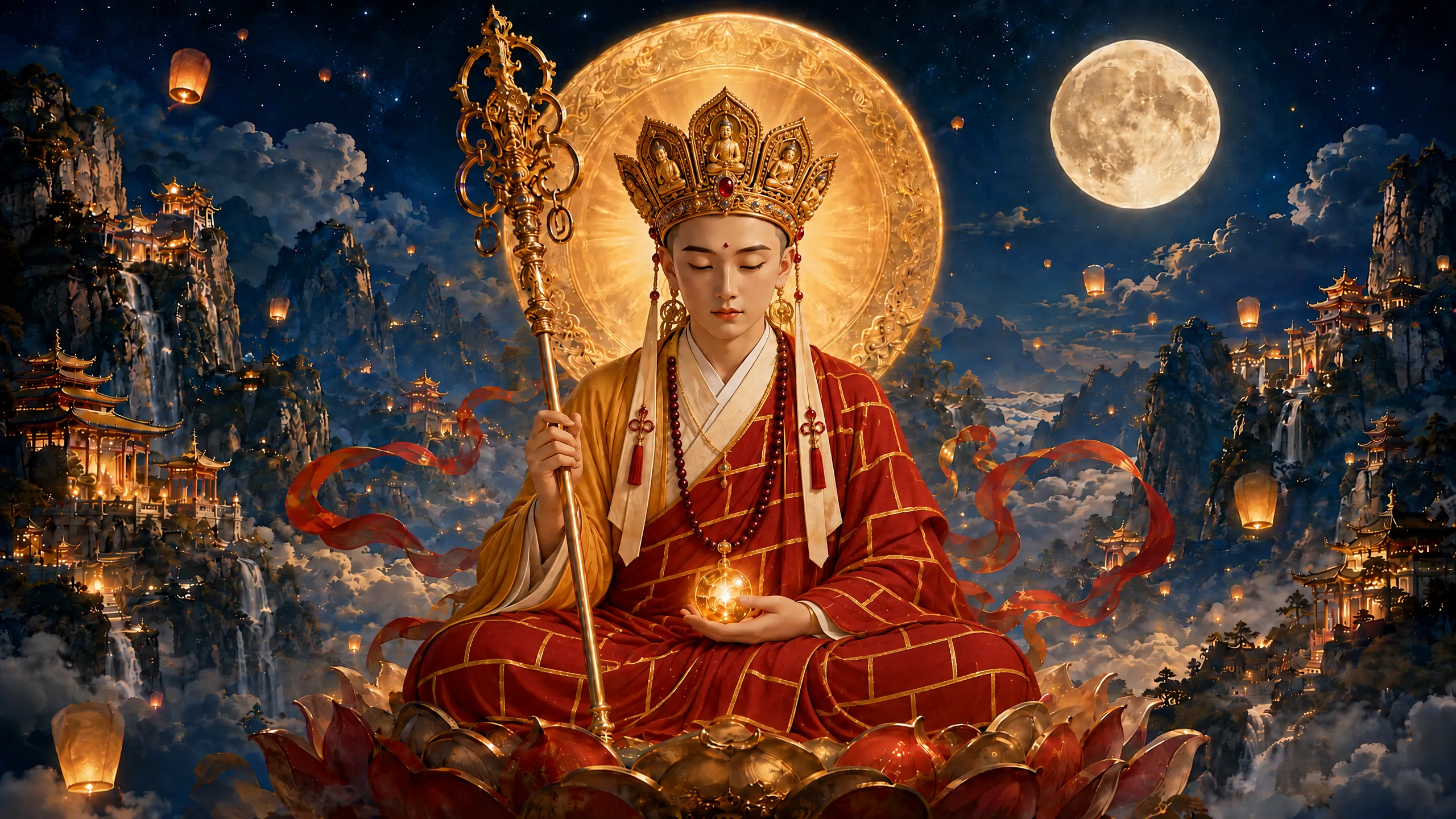
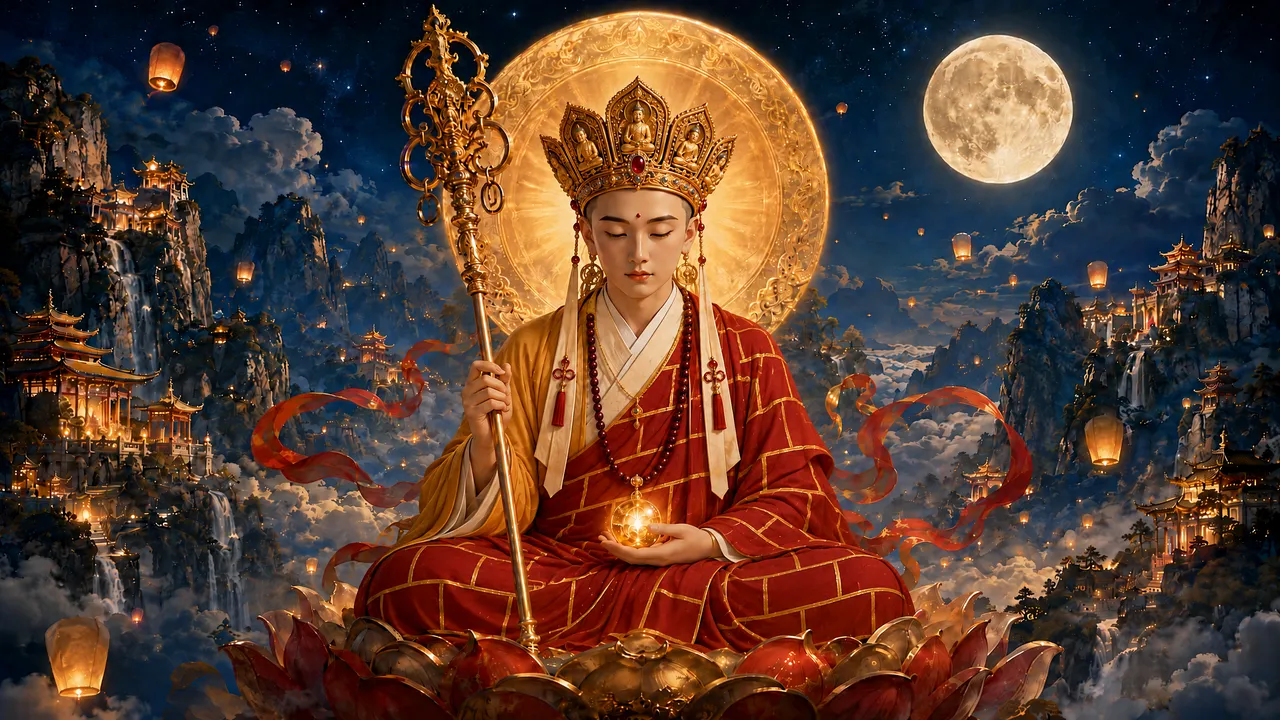
Yet the Ksitigarbha on our cover, though he wears a monk’s robe, also wears a golden crown topped with five small Buddha figures. It is called a five-Buddha crown (五佛冠). This too has a basis:
- Scripture: The Ritual Manual of Ksitigarbha Bodhisattva (地藏菩薩儀軌), attributed to the Tang translator Śubhakarasiṃha (輸婆迦羅), says Ksitigarbha may be painted in two ways: one “in the form of a śrāvaka, wearing a robe,” the other “wearing a heavenly crown on the head, and a robe.”
- Art history: The scholar Zhang Zong (張總) notes that early images show Ksitigarbha in bodhisattva form, and that from the late Tang onward a monk form wearing a hood appears; “by the Ming and Qing periods… the hood on Ksitigarbha’s head was replaced by the five-Buddha crown.” The statue of Kim Jijang on Mount Jiuhua is “dressed as a monk and wearing the five-Buddha crown.”
- Meaning: Taiwan’s National Religion Information Network, run by the Ministry of the Interior, says the five Buddha figures on the crown “inwardly represent the perfection of the five wisdoms.” Today the presiding master at a Flaming Mouth (燄口) ceremony also wears a five-Buddha crown.
The Ringed Staff and the Jewel
- Ringed staff (錫杖): The Sutra of the Ringed Staff (得道梯橙錫杖經) says: “This staff is called the staff of wisdom, and also the staff of virtue,” and that its “twelve rings are for recollecting the twelve links of dependent origination.” The Song-dynasty Essentials of the Buddhist Tradition (釋氏要覽) says: “Two prongs and six rings were designed by Kashyapa Buddha; four prongs and twelve rings were designed by Shakyamuni Buddha.”
- Shaking open the gates of hell: It is often said that Ksitigarbha shakes open the gates of hell with his staff. This is not found in the scriptures. It comes from the Dunhuang Transformation Text on Mulian (目連變文), in which Mulian (Maudgalyayana) rescues his mother: “One shake, and the locks of the black city fall; a second shake, and both leaves of the bright gate swing open.” Only later did ritual texts apply this image to Ksitigarbha, for example: “He shakes the six-ringed golden staff to break open Avici hell; he holds a single bright jewel to light up the Hell of No Interval.”
- Jewel: The Sutra of the Ten Wheels of Ksitigarbha compares Ksitigarbha to a wish-fulfilling jewel: “Like a wish-fulfilling jewel, he rains down all kinds of treasures and fulfills whatever is sought.” The jewel lights up the darkness and grants the wishes of beings.
The Robe on the Cover: The Rice-Field Pattern and the Robe of Merit
The Grid on the Robe Is a Rice Field
The red robe Ksitigarbha wears on the cover is divided into a grid by gold lines. This is called the rice-field pattern (田相). It comes from a story about the Buddha. The Four-Part Vinaya (四分律, the Dharmaguptaka Vinaya) records that the Buddha left Rajagriha and was walking south when he saw some fields along the road:
On the way he saw fields that were well made, with neat, even ridges. Seeing them, he said to Ananda: “Do you see these fields?” … “Can you make robes like this for the monks?”
Seeing how neatly the ridges divided the fields, the Buddha asked Ananda to design robes for the monks modeled on the rice fields. The Pali Vinaya tells the same story and says the fields the Buddha saw were in Magadha; the Mahasanghika Vinaya (摩訶僧祇律) calls them “the rice fields of Magadha.”
Why Is the Robe Cut into Pieces?
A monk’s robe is made by cutting cloth into small pieces and sewing them back together, which is why it is called a cut-and-sewn robe (割截衣). The Four-Part Vinaya says this is done “so that it will not be stripped off by robbers”: cut-up cloth is worth little, so thieves will not take it. The Pali Vinaya likewise says that a robe cut into small pieces has little value, suits a renunciant, and will not be coveted by enemies.
Kasaya and the “Robe of the Field of Merit”
- Kasaya (袈裟): From the Sanskrit kāṣāya, originally the name of a color. The Tang-dynasty Sounds and Meanings of All Scriptures (一切經音義) says: “Here [in Chinese] this means an impure color.” The Buddha ruled that monastic robes be dyed a dull, “spoiled” color (壞色) rather than a bright one, which is why the robe is called kasaya.
- Robe of the field of merit (福田衣): Monastics are like a field; making offerings to them is like sowing seeds in a field, which grows merit. The Essentials of the Buddhist Tradition, quoting the Zenghui ji (增輝記), says: “Rice paddies hold water and grow fine sprouts that nourish bodily life. The fields of the Dharma robe are watered with the four benefits and grow the sprouts of the three goods, nourishing the wisdom-life of the Dharma body.”
Five, Seven and Nine Panels
A panel (條) is one long strip of sewn-together cloth. Monastics have three robes, each with a different number of panels:
| Robe | Panels | When it is worn |
|---|---|---|
| Antarvasa (安陀會) | 5 | In the monastery, while walking or working |
| Uttarasanga (鬱多羅僧) | 7 | At gatherings of the sangha |
| Sanghati (僧伽梨) | 9 or more | When entering a royal palace or a village |
Accounts differ on the most panels the great robe can have: the Four-Part Vinaya goes up to nineteen, while the Sarvastivada Treatise (薩婆多論) goes up to twenty-five.
Why Is the Robe Red?
The monastic rules require robes in a dull color; the Four-Part Vinaya says: “blue, black, or magnolia” (若青、若黑、若木蘭). As for red, the Song-dynasty monk Zanning (贊寧) writes in his Brief History of the Sangha in the Great Song (大宋僧史略): “In the Han and Wei periods, renunciants mostly wore red cloth sanghati robes.” Because the Western Regions had no silk and favored magnolia and gandha (乾陀) colors, “they wore cloth and dyed it red.” He also notes that each school used a different color: “Those who wore red cloth were Dharmaguptaka (曇無德) monks, who simply reached China first.” So red robes appeared in China very early.
Robe colors kept changing over time. In the Tang dynasty, Empress Wu Zetian granted purple robes to Falang (法朗) and eight other monks, and “the granting of purple began here.” Tibetan Buddhist robes are reddish brown, while Theravada (Southern) Buddhism mostly uses yellowish-brown robes dyed with local plants.
How to Chant the Mantra for Eliminating Fixed Karma
- How many times: In the Mengshan Food Offering of the evening service, it is recited three times; the Wondrous Treasure of Peace and Bliss says twenty-one times a day. We found no scriptural basis for the common practice of 108 repetitions. Our chant has 108 repetitions and lasts about 22 minutes.
- When to chant: During the evening service, after reciting the Ksitigarbha Sutra, or on Ksitigarbha’s birthday, the 30th day of the seventh lunar month. Some people also chant it for relatives who have passed away: the Ksitigarbha Sutra’s chapter “Benefiting the Living and the Dead” (利益存亡品) says that if, after a person’s death, “many good deeds are done within seven times seven days, these beings can leave the evil destinies forever and be reborn among humans and gods.”
- What to keep in mind: As Zhixu reminds us, while chanting the mantra we should also “cut off new misdeeds for good” and stop creating new bad karma.
- Listening before sleep: When you listen to the Mantra for Eliminating Fixed Karma before bed, you can silently chant along, or simply listen quietly and let your mind settle little by little.
References
- Tang dynasty, Atikūṭa (阿地瞿多), trans., 《陀羅尼集經》 (Collected Dharani Sutra), fascicle 6 (CBETA T0901)
- Ming dynasty, Zhuhong (袾宏), 《諸經日誦集要》 (Essentials of Daily Recitations from the Sutras), in 《雲棲法彙》 (Collected Works of Yunqi) (CBETA J32nB277); 《諸經日誦集要》, 1662 (Kangxi 1) woodblock edition (CBETA J19nB044)
- Ming dynasty, Zhixu (智旭), 《靈峰宗論》 (Collected Writings of Lingfeng) (CBETA J36nB348)
- Ming dynasty, Zhixu (智旭), 《絕餘編》 (Jueyu Collection), 〈滅定業真言咒壇一百十日圓滿然香懺願文〉 (Incense-Burning Repentance and Vow on Completing the 110-Day Altar of the Mantra for Eliminating Fixed Karma) (CBETA J28nB216)
- Ming dynasty, Zhixu (智旭), 《讚禮地藏菩薩懺願儀》 (Rite of Praise, Repentance and Vows to Ksitigarbha Bodhisattva) (CBETA X1486)
- Ming dynasty, Zhixu (智旭), 《占察善惡業報經義疏》 (Commentary on the Sutra of Divining the Karmic Results of Good and Evil) (CBETA X0371)
- Attributed to Śikṣānanda (實叉難陀, Tang dynasty), trans., 《地藏菩薩本願經》 (Sutra of the Fundamental Vows of Ksitigarbha Bodhisattva) (CBETA T0412)
- Tang dynasty, Xuanzang (玄奘), trans., 《大乘大集地藏十輪經》 (Mahayana Great Collection Sutra of the Ten Wheels of Ksitigarbha) (CBETA T0411)
- Translator unknown, 《大方廣十輪經》 (Great Expansive Ten Wheels Sutra) (CBETA T0410)
- 《地藏菩薩儀軌》 (Ritual Manual of Ksitigarbha Bodhisattva) (CBETA T1158)
- Tang dynasty, Xuanzang (玄奘), trans., 《阿毘達磨俱舍論》 (Abhidharmakosa), fascicle 15 (CBETA T1558)
- Tang dynasty, Yijing (義淨), trans., 《藥師琉璃光七佛本願功德經》 (Sutra of the Original Vows and Merits of the Seven Medicine Buddhas of Lapis Lazuli Light) (CBETA T0451)
- Tang dynasty, Zhanran (湛然), 《法華文句記》 (Notes on the Words and Phrases of the Lotus Sutra) (CBETA T1719)
- Tang dynasty, Amoghavajra (不空), 《總釋陀羅尼義讚》 (General Explanation and Praise of the Meaning of Dharanis) (CBETA T0902)
- Song dynasty, Daoyuan (道原), 《景德傳燈錄》 (Jingde Record of the Transmission of the Lamp), fascicle 4 (CBETA T2076)
- Tsongkhapa, trans. Fazun (法尊), 《菩提道次第廣論》 (The Great Treatise on the Stages of the Path to Enlightenment) (CBETA B0067)
- 《瑜伽集要焰口施食儀》 (Yoga Essentials Flaming Mouth Food-Offering Rite) (CBETA T1320)
- Jin Huichang (金慧暢), ed., 《安樂妙寶》 (Wondrous Treasure of Peace and Bliss) (CBETA B0070)
- Yinshun (印順), 《佛法是救世之光》 (The Buddhadharma Is the Light That Saves the World), 〈地藏菩薩之聖德及其法門〉 (The Holy Virtues and Dharma Gate of Ksitigarbha Bodhisattva) (CBETA Y0024)
- Yinshun (印順), 《華雨集(四)》 (Flower Rain Collection, Vol. 4) (CBETA Y0028)
- Tang dynasty, Fei Guanqing (費冠卿), 〈九華山化城寺記〉 (Record of Huacheng Temple on Mount Jiuhua), in 《全唐文》 (Complete Prose of the Tang), fascicle 694
- Song dynasty, Zanning (贊寧), 《宋高僧傳》 (Song Biographies of Eminent Monks), fascicle 20 (CBETA T2061)
- Song dynasty, Zanning (贊寧), 《大宋僧史略》 (Brief History of the Sangha in the Great Song) (CBETA T2126)
- Qing dynasty, Yirun (儀潤), 《百丈清規證義記》 (Commentary on the Baizhang Rules of Purity) (CBETA X1244)
- Qing dynasty, Lingcheng (靈椉), 《地藏本願經科註》 (Outline and Annotations on the Ksitigarbha Sutra) (CBETA X0384)
- Yinguang (印光), rev., 《九華山志》 (Gazetteer of Mount Jiuhua) (CBETA GA0077)
- 《地藏慈悲救苦薦福利生道場儀》 (Ksitigarbha Ritual of Compassion for Relieving Suffering, Dedicating Merit and Benefiting the Living) (CBETA ZW0052)
- 《四分律》 (Four-Part Vinaya) (CBETA T1428)
- Vinaya Mahāvagga VIII.12 (SuttaCentral, English translation by Brahmali)
- Tang dynasty, Huilin (慧琳), 《一切經音義》 (Sounds and Meanings of All Scriptures) (CBETA T2128)
- Song dynasty, Daocheng (道誠), 《釋氏要覽》 (Essentials of the Buddhist Tradition) (CBETA T2127)
- Song dynasty, Yuanzhao (元照), 《佛制比丘六物圖》 (Illustrated Guide to the Six Requisites of a Monk Prescribed by the Buddha) (CBETA T1900)
- Translator unknown, 《得道梯橙錫杖經》 (Sutra of the Ringed Staff, a Ladder to the Way) (CBETA T0785)
- 〈大目乾連冥間救母變文并圖〉 (Transformation Text on Mahamaudgalyayana Rescuing His Mother from the Underworld, with Illustrations)
- 《西遊記》第五十八回 (Journey to the West, Chapter 58)
- Dharma Drum Publishing (法鼓文化), 《咒語50問》摘文 (Excerpt from 50 Questions about Mantras)
- Zhang Zong (張總), 〈風帽地藏像的由來與演進〉 (The Origin and Development of the Hooded Ksitigarbha Image), Chinese Academy of Social Sciences website, 2013
- Yin Fu (尹富), 〈《地藏菩薩本願經》綜考〉 (A Comprehensive Study of the Sutra of the Fundamental Vows of Ksitigarbha Bodhisattva), 《四川大學學報》 (Journal of Sichuan University), 2007, no. 6
- 內政部全國宗教資訊網 (National Religion Information Network, Ministry of the Interior, Taiwan): 地藏菩薩 (Ksitigarbha Bodhisattva)
- 內政部全國宗教資訊網 (National Religion Information Network, Ministry of the Interior, Taiwan): 五佛冠 (Five-Buddha Crown)
- Wisdom Library: pramardana (Monier-Williams Sanskrit-English Dictionary)
- Tricycle, Who Is Jizo?
- 維基百科 (Chinese Wikipedia): 地藏菩薩 (Ksitigarbha)
- 維基百科 (Chinese Wikipedia): 袈裟 (Kasaya)
- Ming dynasty, 《神僧傳》 (Biographies of Divine Monks), fascicle 8 (CBETA T2064)
- Wisdom Library: oṃ (Monier-Williams Sanskrit-English Dictionary)
- Wisdom Library: svāhā (Monier-Williams Sanskrit-English Dictionary)