
How to Write and Pronounce the Green Tara Mantra
The Green Tara mantra is in Sanskrit. When it reached China and Tibet, it was spelled out phonetically in the local scripts, so there are several ways of writing it, but they all say the same words. (The Chinese characters are chosen only for their sound; the common Taiwanese spelling reads roughly weng da-lie du-da-lie du-lie suo-ha in Mandarin.)
| Source | Spelling |
|---|---|
| Common in Taiwan | 嗡 達咧 都達咧 都咧 梭哈 |
| Method of Reciting Tārā Bodhisattva from the Vajraśekhara Sūtra 《金剛頂經多羅菩薩念誦法》, trans. Amoghavajra 不空 (Tang dynasty)[2] | 唵 多唎 咄多唎 咄唎 薩嚩訶 |
| Sutra of the Twenty-One Praises of the Noble Savior Buddha-Mother 《聖救度佛母二十一種禮讚經》, trans. An Zang 安藏 (Yuan dynasty)[3] | 唵 多哩 咄多哩 都哩 莎訶 |
| Tibetan pronunciation[11] | Om Tare Tuttare Ture Soha |
Two things to watch when you chant:
- Tare is pronounced “TAH-reh” (ta-re), not like the English word “tear.”
- The last word is svāhā in Sanskrit (roughly “svah-hah”); Tibetans usually say “soha” (so-ha).[11] Both pronunciations are common.
What Does Om Tare Tuttare Ture Soha Mean?
In the table below, the middle column gives the literal meaning of the Sanskrit,[11,13] and the right column gives Lama Zopa Rinpoche’s explanation from his 1982 teaching on Tara practice:[6]
| Word | Literal meaning | Lama Zopa Rinpoche’s explanation |
|---|---|---|
| oṃ (嗡) | A sacred seed syllable; a common opening for mantras | Stands for the Buddha’s body, speech, and mind |
| tāre (達咧) | A call: “O Tara!” | Liberation from the suffering of samsara |
| tuttāre (都達咧) | Possibly uttāre, “the savior who pulls beings up out of the ocean of samsara,” with a t added so all three names begin with t and sound alike[15] | Dispels all fears; liberation from karma and delusions |
| ture (都咧) | A call: “O swift one!” | Grants all success |
| svāhā (梭哈) | “May it be auspicious and fulfilled,” a closing word of prayer | May the blessings take root in our hearts |
The Yuan-dynasty Chinese translation of the Twenty-One Praises also explains this mantra in a verse, with the same meaning:[3]
唵敬禮多哩速疾勇,咄多哩者除怖畏,咄哩能授諸勝義,具莎訶字我讚禮。
Oṃ, homage to Tāre, the swift and heroic one; tuttāre dispels all fear; ture grants every supreme benefit; to you with the syllable svāhā, I offer praise and homage.
Put simply, chanting this mantra is calling out to Tara: “O Tara, please swiftly free us from fear and suffering.”
Who Is Green Tara?
Tara’s Chinese name, 度母 (dùmǔ), renders the Sanskrit Tārā (also transliterated 多羅, duōluó). The word comes from the root tṝ, “to cross over,” and by extension means “the savior who carries people across.” The Chinese character 度 (dù) here means the same as 渡 (dù), “to ferry across”: the Commentary on the Mahāvairocana Sūtra 《大日經疏》 says that “tā(ri) means ‘to ferry across’ … it can ferry beings across this great ocean of birth and death.” Like a boat, she carries beings from the ocean of birth and death to the other shore. In Sanskrit, tārā also means “star” and “pupil of the eye,” and the Commentary gives another explanation as well: “tārā means ‘eye.’”
In Tibetan, Tara is called Drolma (sgrol ma, “she who rescues”), and honored as Jetsun Drolma. Chinese scriptures call her Duoluo Pusa 多羅菩薩 (Tara Bodhisattva) and Sheng Jiudu Fomu 聖救度佛母 (Noble Savior Buddha-Mother).
Tara has many forms. The best known are the Twenty-One Taras, and Green Tara is the chief among them. Green stands for the buddhas’ “enlightened activity,” the power to act and rescue beings, which is why Green Tara is known for responding swiftly.
The Story of Green Tara
Born from Avalokiteshvara’s Tears
The most widely told account in Tibetan Buddhism goes like this: Avalokiteśvara (Guanyin) had been saving beings for countless eons, yet he saw that the number of beings suffering in samsara, the cycle of rebirth, had not decreased at all, and he wept in sorrow.[11,13] His tears formed a lake, a blue utpala flower grew in the lake, and from the flower Tara appeared.[11,14] She comforted Avalokiteshvara and vowed to join him in saving beings.[13]
The usual version says the tear from his right eye became Green Tara and the tear from his left eye became White Tara,[14] though some accounts say the reverse. In a telling by the Sakya Trizin, twenty-one lotuses grew in the lake, and twenty-one Taras appeared from them.[13]
Chinese scriptures record something similar. The Mahāvaipulya Mañjuśrī Sūtra 《大方廣曼殊室利經》, translated in the Tang dynasty by the Tripiṭaka master Amoghavajra 不空, says that Avalokiteshvara “emitted a great light from the pupil of the right eye of his face, and with the light flowed forth the form of a wondrous woman.” This female deity, born from the light of Avalokiteshvara’s eye, is Tara Bodhisattva (多羅菩薩).[1]
Princess Wisdom Moon and Her Vow
Another story comes from The Origin of the Tārā Tantra 《度母本源》, written in 1604 by the Tibetan scholar Tāranātha.[7]
Long ago there was a princess named Wisdom Moon (Sanskrit Jñānacandra, Tibetan Yeshe Dawa). For many years she devotedly made offerings to the buddha Dundubhīśvara (“Drum Sound,” 鼓音如來), and she practiced with great diligence.[7,13] The monks urged her: “Your merit is so deep. You should pray to be reborn as a man in your next life, so that you can become a buddha.”[7,10,11]
The princess replied (in essence): “In ultimate truth there is no male and no female. ‘Male’ and ‘female’ are only names, yet they confuse the world. Many wish to attain buddhahood in a man’s body, but no one vows to benefit beings in a woman’s body. So I vow to keep saving beings in a woman’s body until samsara is empty.”[7,10,11]
She practiced according to this vow and attained awakening. From then on, people called her “Tara,” the savior.[7,11,13]
The Two Princesses of Tibet
In the seventh century, the Tibetan emperor Songtsen Gampo married two foreign princesses: Bhrikuti of Nepal (尺尊公主) and Princess Wencheng of Tang China (文成公主).[9,12] They brought Buddha images and the Buddha’s teachings to Tibet, and Tibetans believe both princesses were emanations of Tara.[9,11,12]
Accounts differ on which was Green Tara and which was White Tara. Most English-language sources say Bhrikuti was Green Tara and Wencheng was White Tara,[9,11] while Chinese-language sources mostly say the opposite.[12] These stories are legends, and both versions exist side by side.
The Twenty-One Taras and Atisha
The Tara text most often recited in Tibetan Buddhism is the Praises to the Twenty-One Taras 《禮讚二十一度母》, with twenty-one verses, each praising one Tara. The Chinese Buddhist canon also includes this text, as the Sutra of the Twenty-One Praises of the Noble Savior Buddha-Mother 《聖救度佛母二十一種禮讚經》, translated into Chinese by An Zang 安藏 in the Yuan dynasty. A Qing-dynasty version goes further and gives the body color of each Tara; the first one is green.
The key figure in spreading devotion to Tara in Tibet was the Indian master Atiśa (982–1054). Tara was his personal meditational deity throughout his life, and tradition holds that it was Tara who guided him to go to Tibet to teach. Another legend says Tara foretold that the journey would shorten his life, and he chose to go anyway. Atisha left a practice of the Twenty-One Taras that is still one of the most popular systems today.
Green Tara’s Appearance and Symbolism
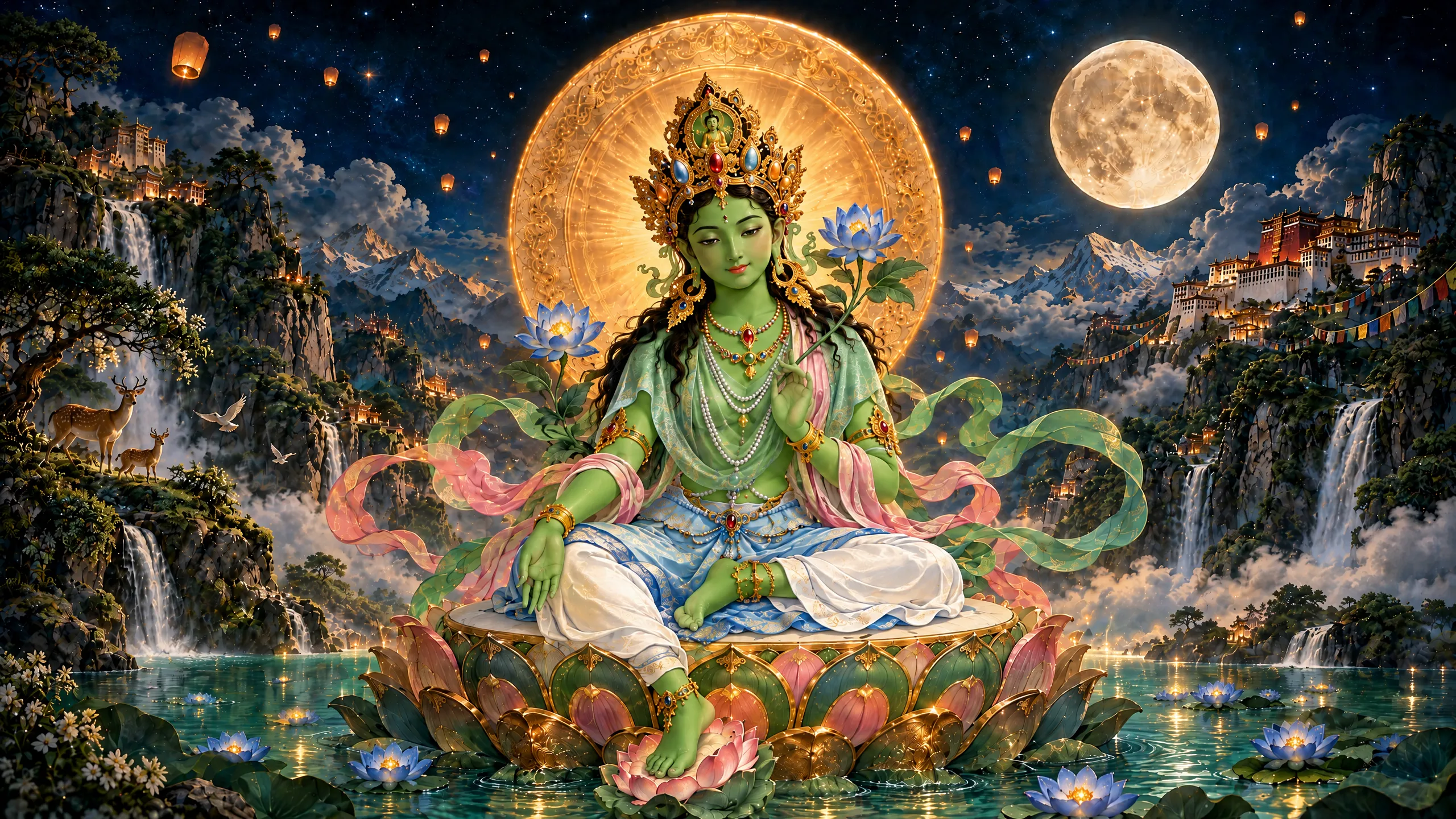
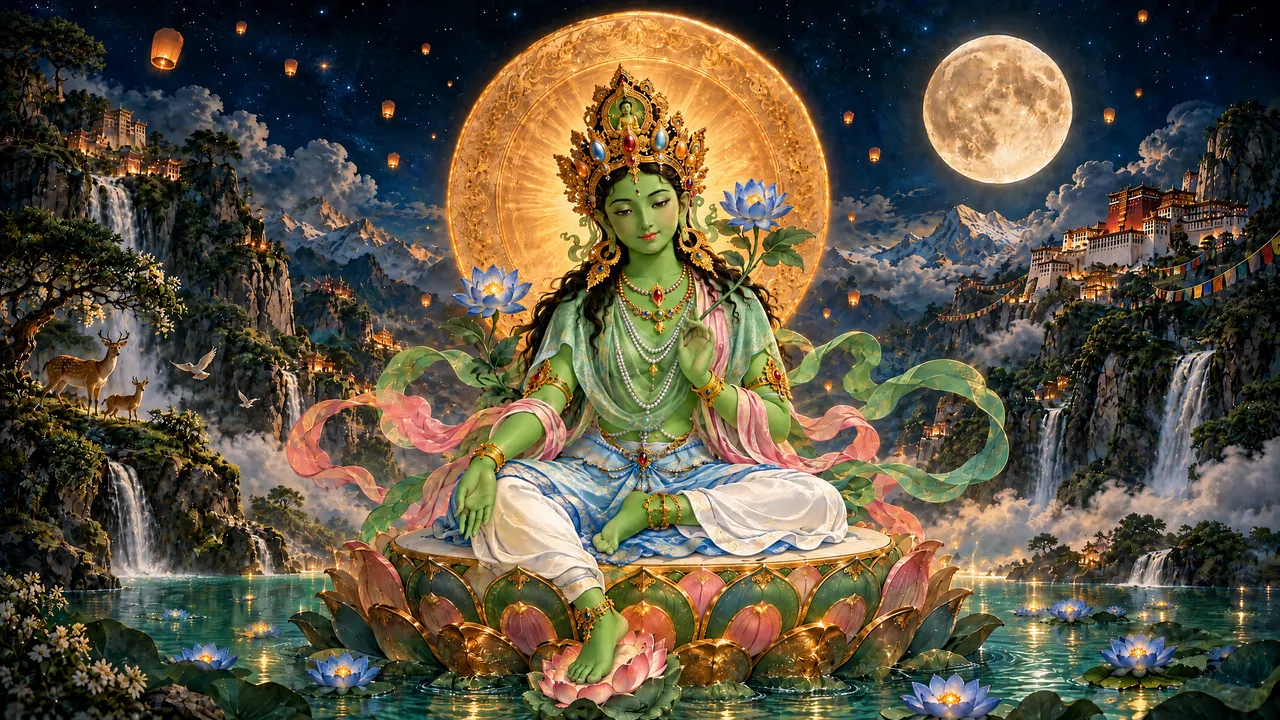
Every detail of Green Tara has a meaning. This site’s cover art follows these features too:
- Green body: the power to act and rescue beings, swiftly and without delay.
- The appearance of a sixteen-year-old girl, smiling: a sign of compassion full of energy.
- Left leg drawn in, right leg extended: the folded left leg stands for inner meditative concentration and wisdom; the extended right leg stands for compassion, ready at any moment to rise and help whoever calls on her.
- Right hand by her knee, palm facing outward: this is the boon-granting gesture (varada mudra), which stands for generosity and fulfilling beings’ wishes.
- Left hand at her heart, thumb and ring finger touching, the other three fingers raised: this is the Three Jewels gesture (also called the refuge gesture), with the three fingers standing for the Buddha, the Dharma, and the Sangha. It is not the gesture of fearlessness.
- Utpala flower: her left hand holds the stem of a blue utpala flower (blue lotus), which blooms beside her left ear.
Chinese esoteric Buddhism pictures her rather differently. In the Avalokiteśvara Court of the Womb Realm Mandala described in the Mahāvairocana Sūtra 《大日經》, Tara is “a mix of blue and white in color, in the form of a middle-aged woman, palms joined, holding a blue lotus”: a middle-aged female deity with her palms pressed together.
The Eight Great Fears Green Tara Protects From
Tara is famous for rescuing beings from the “Eight Great Fears.” Each outer danger corresponds to an inner affliction:
| Outer danger | Inner affliction |
|---|---|
| Lions | Pride |
| Elephants | Ignorance |
| Fire | Hatred |
| Snakes | Jealousy |
| Thieves | Wrong views |
| Chains and prison | Miserliness |
| Floods | Attachment |
| Spirits | Doubt |
This correspondence comes from a verse by the First Dalai Lama, and Lama Zopa Rinpoche’s commentary uses the same scheme. Some Indian texts replace “chains” with “disease.”
Note: In Chinese Buddhism, the "eight difficulties" (八難, bānàn) usually means eight situations in which it is hard to encounter the Buddha's teachings, which is different from the eight fears here. That is why this page calls them the "Eight Great Fears" (八大怖畏).
Green Tara vs. White Tara: What’s the Difference?
Both are Taras and are often honored together, but their focus is different:
| Green Tara | White Tara | |
|---|---|---|
| Body color | Green | White |
| Posture | Right leg extended, ready to rise and rescue | Both legs crossed |
| Prayed to for | Removing fears and obstacles, swift rescue | Long life and health, more merit and wisdom |
| Mantra | Om Tare Tuttare Ture Soha | Om Tare Tuttare Ture Mama Ayur Punye Jnana Pushting Kuru Soha |
The White Tara mantra adds the phrase “Mama Ayur Punye Jnana Pushting Kuru,” which means “please increase my life, merit, and wisdom.” To learn more about White Tara, see the White Tara mantra.
How to Chant the Green Tara Mantra
- How many times: Traditionally you count on a mala (prayer beads), and one round is 108 repetitions. When you are short on time, 21 repetitions is also common.
- When to chant: The Twenty-One Praises mentions chanting in the early morning and at dusk. In fact you can chant at any time; what matters is your focus.
- Before and after: Before you begin, you can set the intention of praying for peace for yourself and for all beings. When you finish, dedicate the merit to all beings.
- Do you need an empowerment? It is generally held that chanting the mantra does not require an empowerment (initiation). If you want to learn the full visualization practice, it is best to ask a qualified teacher.
- Listening at bedtime: When you listen to a Green Tara mantra chant before sleep, you can silently chant along, or simply listen quietly and let your mind settle little by little.
References
- 唐 不空譯《大方廣曼殊室利經》(Mahāvaipulya Mañjuśrī Sūtra, trans. Amoghavajra, Tang dynasty) (CBETA T1101)
- 唐 不空譯《金剛頂經多羅菩薩念誦法》(Method of Reciting Tārā Bodhisattva from the Vajraśekhara Sūtra, trans. Amoghavajra, Tang dynasty) (CBETA T1102)
- 元 安藏譯《聖救度佛母二十一種禮讚經》(Sutra of the Twenty-One Praises of the Noble Savior Buddha-Mother, trans. An Zang, Yuan dynasty) (CBETA T1108A)
- 《大毘盧遮那成佛神變加持經》(Mahāvairocana Sūtra) (CBETA T0848)
- 一行《大日經疏》(Commentary on the Mahāvairocana Sūtra, by Yixing) (CBETA T1796)
- Lama Zopa Rinpoche, Tara Puja and Commentary (1982)
- Tāranātha, The Origin of the Tārā Tantra, trans. David Templeman (LTWA, 1981)
- Himalayan Art Resources: Green Tara
- Rubin Museum: Tara
- Lion’s Roar: Green Tara
- Wikipedia: Tara (Buddhism)
- 維基百科:尺尊公主 (Chinese Wikipedia: Bhrikuti)
- 43rd Sakya Trizin, Gyana Vajra Rinpoche, A Talk on Green Tara Before the Initiation (The Sakya Tradition)
- FPMT Foundation Store: Green Tara by Lama Zopa Rinpoche
- 84000, Praise to Tārā with Twenty-One Verses of Homage (Toh 438, note 1)