
How to Write and Pronounce the White Tara Mantra
The White Tara mantra is a Sanskrit mantra. When it reached Tibet and China, it was spelled out in the local scripts, so it is written in several ways:
| Source | Spelling |
|---|---|
| Common in Taiwan (Chinese characters) | 嗡 達咧 都達咧 都咧 瑪瑪 阿優 布涅 嘉那 布迭 咕如 梭哈 (pinyin: weng da lie du da lie du lie ma ma a you bu nie jia na bu die gu ru suo ha) |
| Qing-dynasty translation by Awang Zhashi 阿旺扎什, Praise of White Tara (白救度佛母讚)[1] | 唵答阿哷都答答阿哷都哷嘛嘛阿俞喇逋吶葉雜尼鴉阿納逋斯真沽嚕葉娑訶 (a syllable-by-syllable transcription in Chinese characters) |
| Sanskrit[10] | oṃ tāre tuttāre ture mama āyuḥ puṇya jñāna puṣṭiṃ kuru svāhā |
| Tibetan pronunciation[12] | om taré tuttaré turé mama ayur punyé jnana pushting kuru soha |
The first half, om tare tuttare ture, is exactly the same as the Green Tara mantra.[10] For the second half, a few points to keep in mind:
- Sanskrit and Tibetan pronunciation differ in four words: āyuḥ is pronounced ayur in Tibetan, puṇya becomes punyé, puṣṭiṃ becomes pushting, and svāhā becomes soha.[10,12] The common Taiwanese spelling, with 布涅 (bu nie) and 梭哈 (suo ha), follows the Tibetan pronunciation. Both pronunciations are very common.
- Jñāna is pronounced “gyah-nah,” starting with a hard g.[11] Wildmind notes that many people also say “nyaa-naa.”[11]
- Puṣṭiṃ is pronounced “poosh-ting”: ṣ sounds like sh, and ṃ is an ng, like the end of “song.”[11] The Taiwanese spelling 布迭 (bu die) leaves out the sh sound.
- Some Tibetan liturgies add a ye after kuru,[17,19] and the Qing translation’s 沽嚕葉 (gu lu ye) has it too.[1] FPMT’s recitation text says this syllable can be said or left out; versions differ.[19]
Our chant mostly follows the Sanskrit (puṇya, svāhā), with jñāna pronounced gyah-nah.
What Does the White Tara Mantra Mean?
| Word | Meaning |
|---|---|
| om tare tuttare ture | Calls on Tara, the same as in the Green Tara mantra[10] |
| mama | “my”[10] |
| āyuḥ (ayur) | life, lifespan (the same word as the āyur in “Ayurveda”)[11] |
| puṇya (punye) | merit, the goodness that comes from ethical conduct and good deeds[11] |
| jñāna | wisdom[10] |
| puṣṭiṃ (pushting) | increase, nourishment[10] |
| kuru | “do it!”, an imperative[11] |
| svāhā (soha) | “may it be auspicious and fulfilled,” the closing word of a prayer[11] |
Āyuḥ, puṇya and jñāna have no Sanskrit case endings, so Visible Mantra concludes that they are really one compound word: āyuḥ-puṇya-jñāna-puṣṭiṃ, “the increase of life, merit and wisdom.”[10] They are written separately to make chanting easier.
Put together, the whole line means: “O Tara… increase my life, merit and wisdom! Svāhā.”[10,11] Visible Mantra points out that kuru is an imperative, so “this is not a request, but a demand!”[10]
Chanting for someone else: mama means “my,” so when you pray for another person, you can replace mama with that person’s name.[10] Some Tibetan practitioners replace it with guru (teacher) to pray for their teacher’s long life.[23]
Where Does the White Tara Mantra Come From?
The White Tara mantra is simply Green Tara’s ten-syllable mantra with a prayer, “mama … kuru,” inserted in the middle.[10] Visible Mantra cites the scholar Stephan Beyer, who describes how Tibetan practice often inserts different phrases into the Tara mantra for different purposes.[10] The phrase inserted in the White Tara mantra is a request for long life, merit and wisdom.[10]
This long mantra comes from Tibetan Buddhist practice:
- Indian Sanskrit practice texts use only the short mantra: an Indian Sanskrit White Tara sadhana, the Mṛtyuvañcanatārāsādhana (meaning “the Tara practice for cheating death”), opens with homage to White Tara but uses “oṃ tāre tuttāre ture svāhā,” which the text calls the “ten-syllable mantra.”[8]
- The Chinese canon includes it only once: the Tara scriptures translated in the Tang and Song dynasties (such as those translated by Bukong 不空, or Amoghavajra) contain only the short mantra, and no White Tara.[2,3] In the Taishō canon, the long mantra appears only in the Praise of White Tara (白救度佛母讚, T1109), translated from Tibetan during the Daoguang reign of the Qing dynasty by Awang Zhashi 阿旺扎什, abbot of Jingzhu Temple (淨住寺) in Beijing.[1] The translation notes that this mantra was “corrected according to the imperial Complete Mantras of the Canon,” meaning it was checked against the Imperially Commissioned Complete Mantras of the Canon (御製大藏全咒) compiled under the Qianlong emperor.[1] The end of the text also records that this praise was spoken by the Second Dalai Lama at Drepung Monastery.[1]
It is still unclear in which scripture this long mantra first appeared.
What Are the Benefits of the White Tara Mantra?
Long life and protection from untimely death: this is the one point every source agrees on. The Indian Sanskrit sadhana mentioned above says that for the practitioner, “the faults of death do not cling” (our own translation). The Qing-dynasty Praise of White Tara prays:
Holy Mother, Tara, Savioress, Mother who increases life, Wish-Fulfilling Wheel: before you, Buddha-Mother, I pray with courage, to dispel the demons that threaten our lives.
聖母度母救度母,增益壽母如意輪,佛母尊前勇祈禱,為消我等壽緣魔。
Venerable Thubten Chodron explains that the power of this mantra lies in purifying the karma that would lead to “untimely death,” dying by accident before one’s lifespan has run out.
Health: the Praise of White Tara says, “In illness and in every hardship, relying on you, we can pray for protection.” In 2018, Lama Zopa Rinpoche advised a student whose breast cancer had returned to do the White Tara practice, visualizing White Tara’s light purifying the illness and suffering. These are statements of faith; when you are ill, please still see a doctor.
Merit and wisdom: the mantra itself asks for both. FPMT says the Wish-Fulfilling Wheel White Tara practice can lengthen life and can also be used to develop wisdom and benefit others.
Note: We have not found any source saying that this mantra helps with sleep. Listening to it at bedtime is simply one way to let the mind settle.
Who Is White Tara?
White Tara’s Sanskrit name is Sitatārā (sita means “white,” and tārā means “one who saves”), and her Tibetan name is sgrol dkar, meaning “the white savioress.” The Qing-dynasty Chinese translation calls her 白救度佛母 (Bai Jiudu Fomu), “the White Savioress Buddha-Mother.”
The White Tara most often practiced in Tibetan Buddhism is fully named Wish-Fulfilling Wheel White Tara (Sanskrit Cintāmaṇicakra, Tibetan yid bzhin ’khor lo), and the Qing Praise of White Tara also calls her “Wish-Fulfilling Wheel.” Note that in Chinese Buddhism, “Wish-Fulfilling Wheel” (如意輪, Ruyilun) usually refers to Ruyilun Guanyin, a form of Avalokiteśvara, who is different from White Tara.
White Tara is one of Green Tara’s emanations. Himalayan Art Resources (HAR) calls White Tara “a longevity bestowing emanation of Green Tara.” Some systems of the Twenty-One Taras also include several white Taras, such as the second, Śuklakānti (“white as the autumn moon”), who has three faces and twelve arms, unlike the usual White Tara with one face and two arms.
Tara is often called a bodhisattva, but HAR points out that her status is in fact that of a fully enlightened buddha, appearing in the form of a beautiful woman.
The Three Long-Life Deities: Amitayus, White Tara and Ushnishavijaya
Tibetan Buddhism groups three deities who grant long life together as the Three Long-Life Deities (Tibetan tshe lha rnam gsum):
- Amitāyus (the Buddha of Infinite Life): a special form of Amitābha Buddha, the main deity in the center.
- Uṣṇīṣavijayā: to the right of the main deity.
- White Tara: to the left of the main deity.
HAR calls the Three Long-Life Deities a Tibetan Buddhist grouping. In the Chinese canon, the other two deities each have their own long-life dhāraṇī: the Uṣṇīṣa Vijaya Dhāraṇī Sutra (佛頂尊勝陀羅尼經, T967) says that reciting it “increases one’s lifespan,” and the Aparimitāyur Dhāraṇī Sutra (無量壽決定光明王如來陀羅尼經, T937) says that reciting it 108 times lets “short-lived beings have their lifespans increased again.”
Every year, disciples offer White Tara images to their teachers, praying that the teachers will live long and remain in the world. Tibetan monasteries also often enshrine the Three Long-Life Deities, especially above the entrance to a temple hall.
The Story of White Tara
Born from Avalokiteshvara’s Tears
According to Tibetan Buddhist tradition, Avalokiteshvara saw that no matter how many beings he saved, there were always more still suffering, and he wept with sorrow.[32,39] One account says two Taras were born from those tears, one white and one green.[32,36]
Accounts differ on which eye’s tear became White Tara: Chinese Wikipedia says the tear from the left eye became White Tara and the tear from the right eye became Green Tara,[36] while Japanese Wikipedia says exactly the opposite.[38]
Chinese scriptures tell it not with tears but with light from the eye. The Great Vaipulya Mañjuśrī Sutra (大方廣曼殊室利經, T1101) says that Avalokiteshvara “emitted a great light from the pupil of the right eye in his face, and with the flowing light there appeared the form of a wondrous woman,” but it does not say whether she was white or green.[2] The Commentary on the Mahāvairocana Sutra (大日經疏, T1796) by Yixing 一行 also says: “Compassion is Avalokiteshvara; this bodhisattva is born from that worthy one’s eye.”[5]
Was Princess Wencheng White Tara?
Tibetans traditionally say that the two princesses who married the Tibetan king Songtsen Gampo in the seventh century were emanations of Tara: Princess Wencheng of Tang China was White Tara, and Princess Bhrikuti of Nepal was Green Tara.[32,40] Chinese Wikipedia also records the opposite version, but without citing a source.[37]
This legend arose later. The source English Wikipedia cites is The Clear Mirror of Royal Genealogies (西藏王統記), written in the fourteenth century,[39,43] some seven hundred years after Princess Wencheng came to Tibet. Earlier Tibetan records from Dunhuang give only her name and say nothing about Tara.[40]
Atisha and the Practice of “Cheating Death”
White Tara’s long-life practice is generally traced to Vāgīśvarakīrti, a scholar at the Indian monastery of Vikramaśīla.[14,33] He was one of Vikramashila’s six “gatekeeper” scholars[14] and is said to have been the first to link White Tara with “cheating death” and granting long life.[33] The Tara he saw in meditation was a sixteen-year-old girl, an image the scholar Beyer describes as the opposite of death in every way.[33]
Accounts of Vagishvarakirti’s dates differ (the 9th to 10th centuries, or the 10th to 11th).[9,33] His work Instructions on Cheating Death (Mṛtyuvañcanopadeśa) was translated into Tibetan around 1042 by Atiśa and Rinchen Zangpo at Tholing Monastery in Tibet.[9]
According to the Tibetan lineage prayer, Atisha’s White Tara lineage runs: Wish-Fulfilling Wheel Tara → Vagishvarakirti → Serlingpa → Atisha → Dromtönpa.[14] Of the four main White Tara lineages HAR lists today, Atisha’s is one; the other three are the lineages of Bari Lotsawa, Shakya Shribhadra and Nyen Lotsawa.[25]
Throughout his life, Atisha took Tara as his personal meditation deity.[22,33] It is said that Tara told him in a dream that going to Tibet would shorten his life but would let the Dharma flourish there again, and he chose to go anyway.[32,33] There are many versions of this story; some biographies say only that Tara told him the journey would be “of the greatest benefit.”[22]
Zanabazar’s White Tara
Zanabazar, the first Jebtsundamba of Mongolia, was an outstanding Buddhist sculptor, and his gilt-bronze White Tara, cast in the late seventeenth century, is one of his most famous works.[33,42] He is said to have modeled it on his companion, who died young at just eighteen, so his White Tara looks like an innocent young girl.[33] The statue is now in the Zanabazar Museum of Fine Arts in Ulaanbaatar.[42]
White Tara’s Appearance and Symbolism
Tibetan iconographic texts describe White Tara like this:
- A white body, like the autumn moon: white stands for “pacifying,” calming disasters, illness and suffering. The Praise of White Tara says her “face is like the bright autumn moon.” The Twenty-One Praises of Tara (聖救度佛母二十一種禮讚經, T1108A), praising the second, white Tara, likewise says, “Homage to the Mother like a hundred bright autumn moons.”
- Seven eyes: three on her face, plus one on each palm and one on the sole of each foot, which is why she is also called the Seven-Eyed Mother. Accounts of what the seven eyes mean differ. One account says the three eyes on her face stand for the perfection of body, speech and mind, and the four on her hands and feet for the Four Immeasurables: loving-kindness, compassion, sympathetic joy and equanimity. Another view holds that the seven eyes see the causes and conditions behind all illness and suffering. Not every lineage paints seven eyes; in Bari Lotsawa’s lineage, for example, she has only three.
- The appearance of a sixteen-year-old girl: a symbol of youth and life, the opposite of death.
- Right hand in front of the right knee, palm facing outward: this is the boon-granting gesture, which stands for generosity and fulfilling the wishes of beings.
- Left hand at her heart, the thumb and ring finger (according to some sources, the index finger) holding a flower stem, with the flowers opening beside her left ear.
- Three flowers on one stem: one a bud, one in full bloom and one already bearing fruit, representing the buddhas of the past, present and future. Accounts of the flowers’ color differ: blue utpala, white utpala, or white lotus.
- Legs crossed: this is the vajra posture, which stands for steady meditation. She sits on a moon disc on a lotus, with another moon disc behind her.
- Amitayus above her head: a praise by the First Dalai Lama says White Tara’s head is adorned with Amitayus, which matches her power to grant long life.
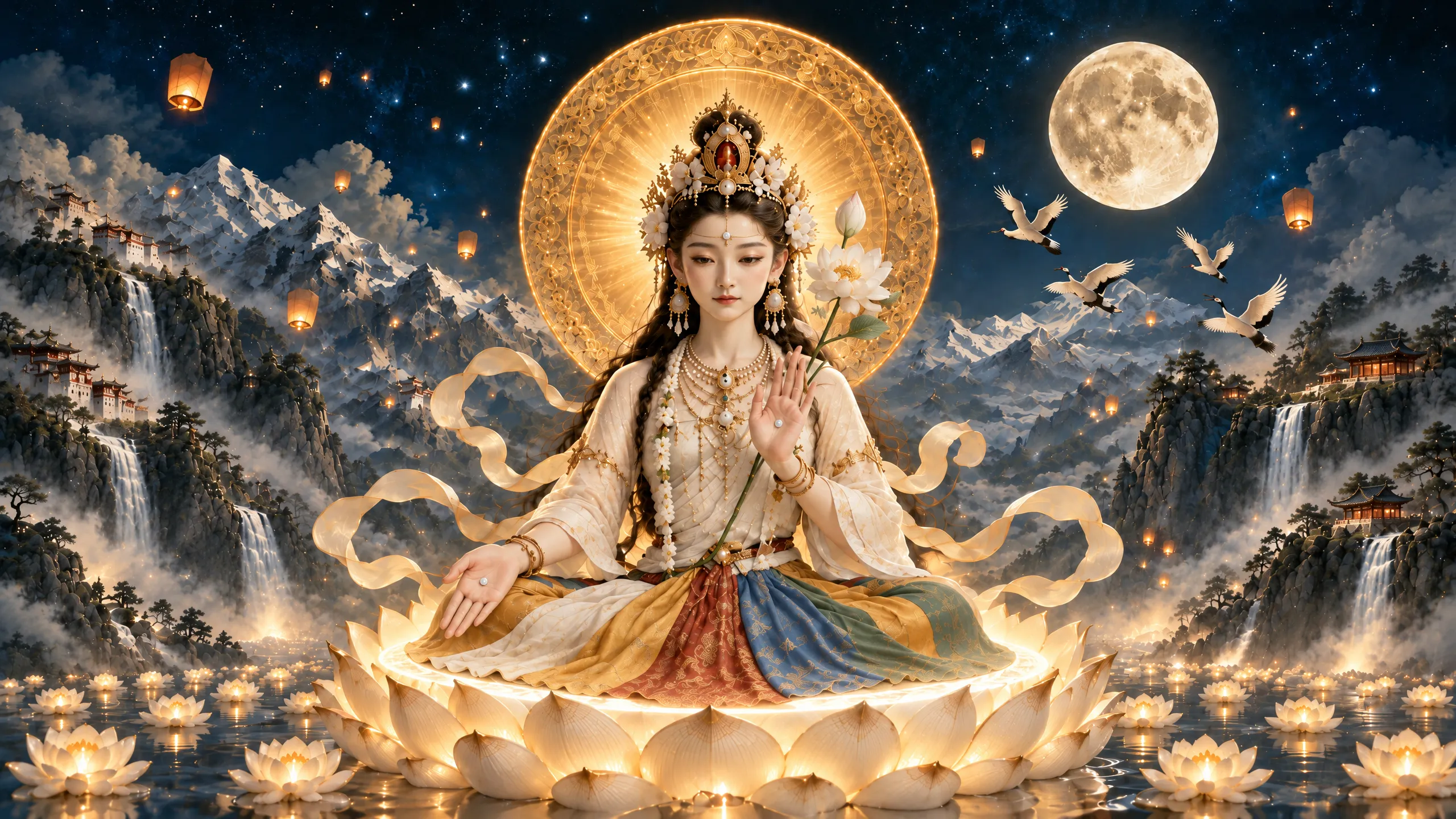
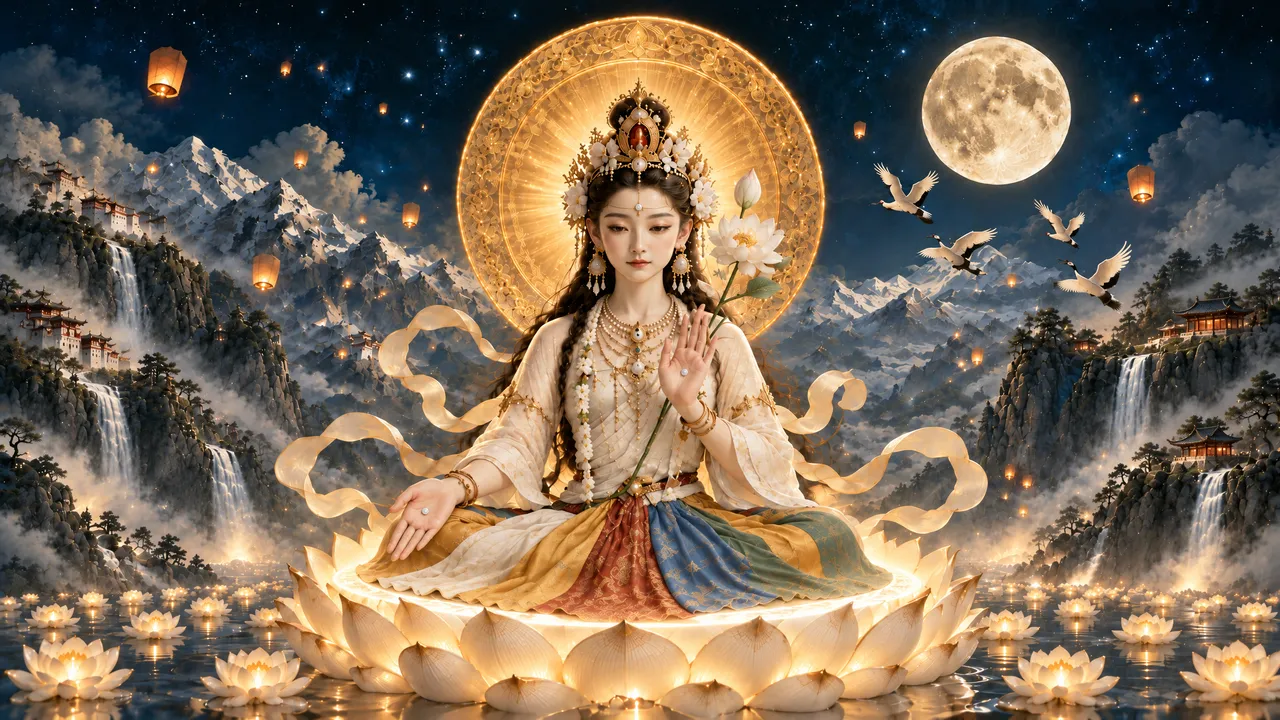
The White Crane and Full Moon on Our Cover
The cover art on this site shows White Tara on a lake on a moonlit night, and the scenery around her is also connected with long life:
- White cranes: the “Six Symbols of Long Life,” a common picture in Tibet, includes a pair of white cranes; in China, too, the crane is a symbol of long life.
- Cliffs, flowing water and trees: rock, water and trees are also among the “Six Symbols of Long Life.”
- The full moon: White Tara’s body is “white as the autumn moon.”
- The waterfall, birds and flowers: the Buddhist scholar Edward Conze describes Tara’s pure land as full of birdsong, the sound of waterfalls and flowers everywhere.
The cover does not show the seven eyes or the moon-disc seat of traditional paintings, so please go by the description in the previous section.
White Tara’s Pure Land and Sacred Sites
- The Pure Land Adorned with Turquoise Leaves (Tibetan Yulokod): Tara’s pure land. An aspiration prayer by Sera Khandro describes Noble Tara seated on a lotus and full moon at the center of this pure land.
- Nyethang Drolma Lhakhang, Tibet: a Tara temple about 33 km (20 miles) from Lhasa, where Atisha passed away. It houses twenty-one life-size bronze statues of Tara.
- Dzongsar Monastery, Tibet: Jamyang Khyentse Wangpo once enshrined a statue of Wish-Fulfilling Wheel White Tara here, said to give teachings and prophecies. The statue was rescued in 1967 and later brought to India.
- Mongolia: seven-eyed White Tara is especially popular in Mongolia.
What Is the Difference Between Green Tara and White Tara?
Both are Tara and are often worshipped together, but they have different emphases:
| Green Tara | White Tara | |
|---|---|---|
| Body color | Green | White |
| Posture | Right leg extended, ready to rise and help at any moment | Both legs crossed |
| Prayed to for | Removing fear and obstacles, swift rescue | Long life and health, more merit and wisdom |
| Mantra | Om Tare Tuttare Ture Soha | Om Tare Tuttare Ture Mama Ayur Punye Jnana Pushting Kuru Soha |
To learn more about Green Tara, see the Green Tara mantra page.
How to Chant the White Tara Mantra
- How many times: Tibetan teachers such as Lama Zopa Rinpoche and Thubten Chodron teach that you first recite the long White Tara mantra 21 times, then recite the short mantra (that is, the Green Tara mantra) as many times as you can. We have not found any scriptural basis specific to White Tara for the common count of 108; the Chinese Tara scriptures, however, do say to “recite the deity’s dhāraṇī 108 times.” Accounts of how many recitations a retreat requires differ, from 300,000 to 10 million. Our chant has 108 repetitions and lasts about 41 minutes.
- How to recite: the Sutra of the Heart Dhāraṇī of Avalokiteśvara’s Tārā (觀自在菩薩怛嚩多唎隨心陀羅尼經, T1103b), translated by Zhitong 智通 in the Tang dynasty, says, “neither slow nor hurried, just loud enough to hear oneself”: not too fast or too slow, and so quiet that only you can hear it. Thubten Chodron reminds us to say every syllable clearly rather than mumbling, and, while reciting, to truly feel that your life is growing longer.
- How to visualize: Lama Zopa Rinpoche says that people who have not received an initiation can visualize White Tara above their head or in front of them.
- Who to chant for: for yourself, for family and friends who are ill, or for your teacher’s long life. When chanting for someone else, you can replace “mama” with that person’s name.
- Do you need an initiation? It is generally held that reciting the mantra does not require an initiation, but it is best to first receive the oral transmission from a teacher. Visualizing yourself as White Tara, or doing the full Wish-Fulfilling Wheel sadhana, does require an initiation. If you would like to learn the complete practice, please consult a qualified teacher.
- Listening before sleep: when you listen to the White Tara mantra chant at bedtime, you can recite along silently or simply listen quietly, letting your mind settle little by little.
References
- Awang Zhashi 阿旺扎什 (Qing), 《白救度佛母讚》 (Praise of White Tara) (CBETA T1109)
- Bukong 不空 (Amoghavajra, Tang), 《佛說大方廣曼殊室利經》 (Great Vaipulya Mañjuśrī Sutra) (CBETA T1101)
- Zhitong 智通 (Tang), 《觀自在菩薩怛嚩多唎隨心陀羅尼經》 (Sutra of the Heart Dhāraṇī of Avalokiteśvara’s Tārā) (CBETA T1103b)
- Ancang 安藏 (Yuan), 《聖救度佛母二十一種禮讚經》 (Twenty-One Praises of Tara) (CBETA T1108A)
- Yixing 一行, 《大日經疏》 (Commentary on the Mahāvairocana Sutra) (CBETA T1796)
- Fotuoboli 佛陀波利 (Buddhapāli, Tang), 《佛頂尊勝陀羅尼經》 (Uṣṇīṣa Vijaya Dhāraṇī Sutra) (CBETA T0967)
- Fatian 法天 (Song), 《佛說大乘聖無量壽決定光明王如來陀羅尼經》 (Aparimitāyur Dhāraṇī Sutra) (CBETA T0937)
- Mṛtyuvañcanatārāsādhana, ed. Schneider 2010 (GRETIL / TextGrid)
- Péter-Dániel Szántó, Vāgīśvarakīrti (2020)
- Visible Mantra: White Tārā
- Wildmind: White Tara mantra
- Lotsawa House: Concise White Tara Sadhana
- Lotsawa House: White Tārā
- Lotsawa House: White Tārā According to Atiśa’s Tradition
- Lotsawa House: Tara Pureland Aspiration
- Lotsawa House: History of the Tara Image
- Lama Zopa Rinpoche, White Tara practice (2018)
- Lama Zopa Rinpoche, White Tara meditation (2017)
- FPMT, Practices for Lama Zopa’s Long Life (2011)
- FPMT, White Tara Mantra
- FPMT, White Tara Chintachakra Long Sadhana
- FPMT, Atisha biography
- Thubten Chodron, What the Tara mantra means
- Thubten Chodron, Focus on recitation
- Himalayan Art Resources: White Tara
- Himalayan Art Resources: Wish-fulfilling Wheel
- Himalayan Art Resources: Iconography texts
- Himalayan Art Resources: Lineages
- Himalayan Art Resources: Three Long Life Deities
- Himalayan Art Resources: Six Symbols of Long Life
- Himalayan Art Resources: Peaceful appearance
- Huntington Archive, The Taras of Nepal
- Asian Art: Zanabazar’s White Tara
- Robert Beer, White Tara
- Meng Jun 孟君, 〈長壽三尊〉 (The Three Long-Life Deities), 《收藏家》 (Collector), 2010 (臺大佛學數位圖書館 (NTU Digital Library of Buddhist Studies))
- 維基百科:多羅菩薩 (Chinese Wikipedia: Tara)
- 文成公主 (Chinese Wikipedia: Princess Wencheng)
- 多羅菩薩(日文) (Japanese Wikipedia: Tara)
- Wikipedia: Tara (Buddhism)
- Wikipedia: Princess Wencheng
- Wikipedia: Nyethang Drolma Temple
- Wikipedia: Zanabazar
- 西藏王統記 (Chinese Wikipedia: The Clear Mirror of Royal Genealogies)